
What if your spring allergies aren’t just bad luck, but a sign that your current plan is missing important triggers? In Fresno, oak, mulberry, and... Continue reading
READ MORE

What if the most useful clue isn’t a suspected trigger, but the pattern of your child’s symptoms? A stuffy nose that returns each spring, a recurring rash, coughing, or a reaction after eating can leave you wondering whether allergies are involved. Searching “pediatric allergist Fresno” is a natural next step, but you don’t need to know the cause before seeking an evaluation.
It’s understandable to have questions about what an evaluation involves, whether testing could help, and how your child might respond. A specialist can review symptoms and relevant health history to guide next steps, rather than relying on guesswork. Fresno-area families can access outpatient allergy and respiratory specialty care for concerns including allergic rhinitis, asthma, food allergies, and atopic dermatitis.
This guide explains when recurring symptoms may merit an allergy-focused evaluation, what information to bring, and which questions can make a visit more productive. You’ll also learn how testing may help clarify a concern and how personalized care can support a practical plan for your child.
Recurring symptoms can affect more than a child’s comfort. A blocked or runny nose may interrupt sleep, itchy skin can make it hard to focus at school, and coughing or other breathing symptoms can get in the way of play. When symptoms keep returning, an allergy-focused evaluation can help explore possible causes instead of relying on guesses about triggers.
Parents may notice sneezing or congestion at particular times of year, recurring itchy or inflamed skin, cough or wheezing in certain settings, or symptoms after eating a particular food. These patterns can guide a conversation, but they don’t prove an allergy. Infections, irritants, and other conditions can cause similar symptoms. The overview of Allergies in children provides additional context on possible symptoms, causes, diagnosis, and management.
An allergy-focused evaluation can be useful when recurring symptoms, suspected reactions, or possible triggers affect daily life and need a closer look. You don’t have to identify the cause before looking for specialty care in Fresno.
Consider discussing symptoms with a specialist when they persist, recur, or seem connected to particular exposures. For example, note whether nasal symptoms return in a familiar setting, a rash flares repeatedly, breathing symptoms accompany activity or exposure, or a reaction follows a particular food. A symptom list can’t diagnose an allergy, but a detailed pattern gives the clinician useful context.
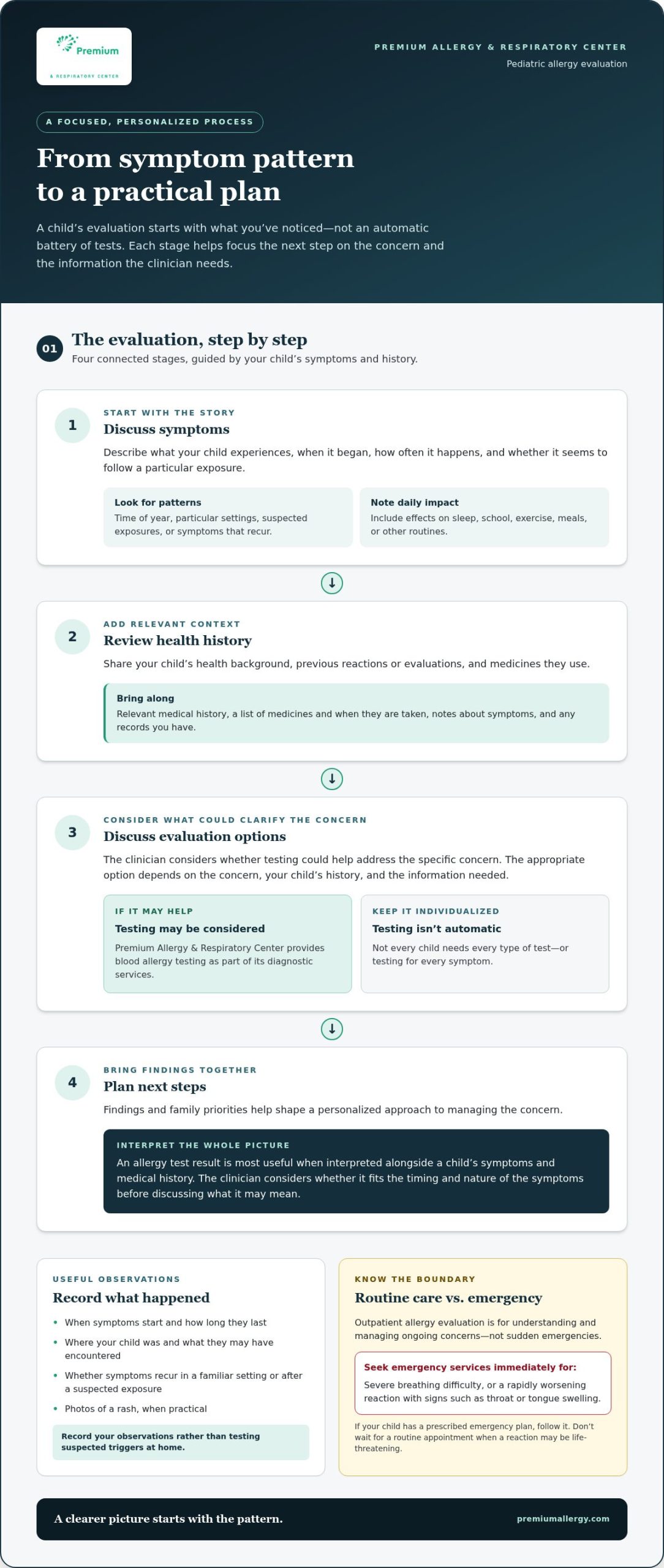
Keep a simple record of when symptoms start, where your child is, what they may have encountered, how long symptoms last, and whether they affect sleep, school, or activities. Photos of a rash, when practical, can also help show what you’ve observed. Focus on recording what happened rather than testing suspected triggers at home.
Routine outpatient allergy evaluation is for understanding and managing ongoing concerns, not sudden emergencies. If your child has severe breathing difficulty or a rapidly worsening reaction with signs such as throat or tongue swelling, seek emergency services immediately. If your child has a prescribed emergency plan, follow it. An outpatient allergy clinic is not an emergency service, so don’t wait for a routine appointment when a reaction may be life-threatening.
For recurring symptoms that are not severe or rapidly worsening, a specialty evaluation can help clarify what may be contributing. Bring your observations and questions to support a thoughtful next step, without assuming every cough, rash, or reaction is allergic.
An allergy evaluation is a focused conversation and clinical assessment, not an automatic battery of tests. If you’re preparing to see a pediatric allergist in Fresno, expect the discussion to center on what your child experiences, when it happens, and what question the visit needs to answer. This keeps the next steps relevant to your child instead of relying on a one-size-fits-all approach.
The process generally moves through a few connected stages:
Details can reveal useful patterns. Note whether symptoms happen at certain times of year, in particular settings, after a suspected exposure, or repeatedly over time. Include how they affect sleep, school, exercise, meals, or other routines. Bring relevant medical history and a list of medicines, including what your child takes and when. These details help focus the evaluation on the clinical question rather than a broad, preset panel.
Testing may be considered when it can help clarify a suspected allergen or guide management. Premium Allergy & Respiratory Center provides blood allergy testing as part of its diagnostic services. The appropriate option depends on the concern, the child’s history, and the information the clinician needs. Testing isn’t automatically necessary for every symptom or every child. For food-specific context, the food allergy clinic guide discusses evaluation and safety considerations.
“An allergy test result is most useful when interpreted alongside a child’s symptoms and medical history.” A result by itself doesn’t describe the full clinical picture. The clinician considers whether it fits the timing and nature of the reported symptoms before discussing what it may mean for your child.
Make the visit more productive by bringing notes, questions, and any relevant records you have. The goal is a clearer understanding of the concern and a practical plan shaped around your child. Families looking for Fresno allergy and respiratory specialty care can explore an outpatient evaluation.
The right setting depends on what your child needs. A pediatrician provides broad care for children’s health and can address general concerns over time. An allergy specialist focuses on allergic and respiratory conditions. Emergency care is for severe or rapidly worsening symptoms that need immediate attention. These roles can complement one another; seeing a specialist doesn’t make general pediatric care less important.
| Care setting | Focus | A useful fit when |
|---|---|---|
| General pediatric care | Broad health concerns, routine care, and coordination of ongoing needs | Your child has a general health concern or needs continued care across different aspects of health. |
| Allergy-specialty evaluation | Focused assessment and management of allergic and respiratory concerns | Recurring or suspected allergy-related symptoms need a closer, focused evaluation. |
| Emergency care | Immediate response to potentially life-threatening or severe, rapidly worsening symptoms | Your child has severe breathing difficulty or a serious reaction requiring urgent attention. |
A suspected allergy doesn’t automatically mean your child needs specialist testing. Symptoms can have different causes, and the right first step depends on their pattern, severity, and effect on daily life. A pediatrician can assess a broad concern; a specialist evaluation can focus on questions about allergies or related breathing symptoms.
An allergy-focused assessment can look more closely at conditions such as allergic rhinitis, asthma, food allergies, and atopic dermatitis. The clinician considers the child’s symptoms and relevant history, then determines whether testing could help answer a specific question. When testing is appropriate, results are interpreted in context and can inform a personalized management plan.
For example, recurring breathing concerns may call for a different discussion than a suspected food reaction or persistent nasal symptoms. Testing isn’t required for every child, and a symptom alone doesn’t confirm an allergy. Specialty care brings the relevant clues together to clarify practical next steps. Families searching for a pediatric allergist in Fresno can consider whether their main concern calls for this focused expertise.
General pediatric and allergy-specialty care can work alongside each other: one addresses a child’s wider health needs, while the other focuses on allergic and respiratory concerns. For sudden severe symptoms, don’t wait for a routine visit. Seek emergency services for severe breathing difficulty or a potentially life-threatening reaction. An outpatient allergy practice provides specialty evaluation and management, not emergency care.
For ongoing concerns that are not urgent, the choice needn’t feel like an either-or decision. A general pediatric visit can support broad care, while an allergy-focused evaluation can add detail when recurring symptoms point toward a specific allergy or respiratory question.
A little preparation can turn scattered observations into a clearer account of what your child experiences. Whether you’re coming from Fresno, Clovis, Selma, or North Clovis, you don’t need to identify the cause in advance. A simple record of symptoms, possible exposures, and effects on daily life gives the clinician useful context and helps you make the most of the conversation.
Use a phone note or small notebook to capture episodes as they happen. Record when symptoms start, how long they last, what was happening beforehand, and whether the pattern repeats. Include possible connections to meals, outdoor settings, pets, or particular environments, but treat these as observations rather than confirmed triggers.
The goal isn’t to monitor every moment or draw a conclusion from one episode. A few specific examples can be more useful than trying to remember a long stretch of symptoms during the visit.
Gather information that helps fill in your child’s health picture. Bring relevant medical records or prior test information, if available, along with a current medication list that includes names and how your child uses each medicine. You can also write down your main concerns so the questions that matter most don’t get lost in the conversation.
If breathing symptoms are part of your concern, note when they occur and how they affect activity. The asthma management plan guide can help you think through questions about managing asthma alongside an evaluation.
These notes can help a pediatric allergist Fresno families visit understand the concern in context and consider a personalized path forward. Once you’ve gathered what’s available, explore allergy and respiratory specialty care in Fresno.
When a child’s symptoms keep raising questions, a focused evaluation can help bring the pieces together. Premium Allergy & Respiratory Center is a Fresno-based outpatient allergy and respiratory specialty practice serving families in Fresno, Clovis, Selma, and North Clovis. Care is shaped around the concerns being evaluated, the child’s symptom history, and relevant clinical findings, rather than assuming every child needs the same tests or plan.
A focused visit gives parents an opportunity to discuss possible triggers and practical next steps. The evaluation assesses the concern and considers how allergy and respiratory specialty care may fit your child’s needs.
Different symptom patterns raise different questions for an allergy-focused evaluation. Persistent nasal symptoms may relate to allergic rhinitis, while recurring breathing concerns call for a discussion of asthma management. Food-related concerns can be explored through food allergy evaluation and testing. Atopic dermatitis care can address ongoing skin symptoms, and blood allergy testing can help answer a clinical question when appropriate.
These are areas of specialty care, not a checklist every child must complete. The right focus depends on the symptoms and evaluation. For families exploring persistent nasal symptoms, the allergic rhinitis specialist guide offers more context.
Bring observations that best describe your child’s experience, along with relevant history and questions. An evaluation can clarify which concerns merit attention and inform next steps tailored to your child. Testing may be considered when appropriate, but it isn’t automatic, and results are considered alongside the broader clinical picture.
Premium Allergy & Respiratory Center provides outpatient allergy and respiratory specialty care for Fresno-area families, including those in Clovis, Selma, and North Clovis. Care addresses concerns such as rhinitis, asthma, food allergy, and dermatitis. Explore specialty care with Premium Allergy & Respiratory Center.
You don’t need every answer before seeking guidance. A clear account of what your child experiences and what you hope to understand can be a useful starting point. An evaluation can help shape a thoughtful next step based on your child’s individual concerns.
If you’re considering a pediatric allergist Fresno families can turn to, focus on moving forward with questions rather than assumptions. Specialty care can help assess ongoing allergy and respiratory concerns.
Explore specialty allergy and respiratory care for your family and take a step toward understanding your child’s needs.
Consider an allergy-focused visit if a recurring concern keeps disrupting routines or remains unexplained after you’ve tracked its pattern. For example, if nasal symptoms return during the same season each year or a suspected food reaction raises ongoing questions, a specialist can help assess whether allergy care may be relevant. Families in Fresno, Clovis, Selma, and North Clovis can access local outpatient specialty care.
Yes. Allergy specialists evaluate allergic conditions and provide asthma management, which can help when a child has both nasal or skin symptoms and breathing concerns. The conditions can overlap, but one doesn’t automatically cause the other. Share whether coughing, wheezing, or breathlessness occurs during exercise, at night, or around particular exposures so the clinician can consider the pattern in context.
The first visit generally focuses on understanding the reason for the appointment and your child’s health context. A parent or caregiver can explain what the child has experienced and which questions matter most. Depending on the concern, the clinician may discuss whether further evaluation is useful. You can also tell the team if your child feels anxious about medical visits so the conversation can account for that concern.
Follow the instructions provided for your child’s specific evaluation, since preparation can depend on the test being considered. Don’t stop prescribed medicines or change how your child takes them unless the clinician gives that direction. Explain the visit in calm, simple terms, and let your child know they can ask questions. If you haven’t received preparation instructions, get guidance before making changes to medication or routine.
Some children may outgrow certain food allergies, while others continue to have them; the outlook depends on the child and the specific allergy. Don’t test whether an allergy has resolved by offering the food at home. A clinician can assess the child’s history and determine whether a supervised evaluation is appropriate. Keep following the child’s existing food-allergy guidance unless their care team recommends a change.
Referral requirements can depend on your health plan and its rules for specialty care. Before arranging an evaluation, review your plan documents or contact the insurer to ask whether a referral is needed and whether the specialist visit is covered under your benefits. If your child has relevant medical records or previous evaluation notes, having them available can provide helpful context for the appointment.
Coverage varies by insurance plan, the type of testing, and the terms of your benefits, so don’t assume every test is covered. Contact your insurer before testing to ask about coverage, referral or authorization requirements, and possible out-of-pocket costs. The insurer can explain your plan’s benefits; the clinician determines whether testing is appropriate for your child’s concern. To discuss an allergy or respiratory concern with Premium Allergy & Respiratory Center, explore local specialty care.
What if your spring allergies aren’t just bad luck, but a sign that your current plan is missing important triggers? In Fresno, oak, mulberry, and... Continue reading
READ MORE
What if the most useful clue isn’t a suspected trigger, but the pattern of your child’s symptoms? A stuffy nose that returns each spring, a recurring... Continue reading
READ MORE
Fresno’s allergy season doesn’t have one reliable start date. Symptoms may appear in spring, then return in summer or fall. That uncertainty is... Continue reading
READ MORE
What if lasting relief doesn’t require choosing between endless cleaning and relying on medication forever? Year-round sneezing, congestion, itchy... Continue reading
READ MORE