
Could another allergy evaluation clarify why your symptoms persist, rather than simply repeat the same tests? If you’re searching “second opinion for... Continue reading
READ MORE

Could another allergy evaluation clarify why your symptoms persist, rather than simply repeat the same tests? If you’re searching “second opinion for allergy diagnosis Fresno,” you may be looking for more than another test result. You want to understand how your diagnosis was reached and whether it fits what you’re experiencing.
It’s understandable to feel uncertain when symptoms continue or past results haven’t answered your questions. A useful second opinion brings together your medical history, symptoms, previous test results, and response to treatment. At Premium Allergy & Respiratory Center in Fresno, a specialty evaluation can help review questions about allergic rhinitis, asthma, food allergies, and other allergy and respiratory conditions. This article explains when another evaluation may help, what to bring, and how a specialist considers whether additional testing is relevant. You’ll also learn how to make the most of the discussion and understand your next steps.
Persistent symptoms or test results that don’t seem to match your experience can leave you wondering what to do next. You may be following a care plan but still dealing with congestion, itching, rashes, breathing symptoms, or reactions you can’t explain. Or you may have received a diagnosis without understanding how the evidence supports it. These are useful questions to bring to a specialist.
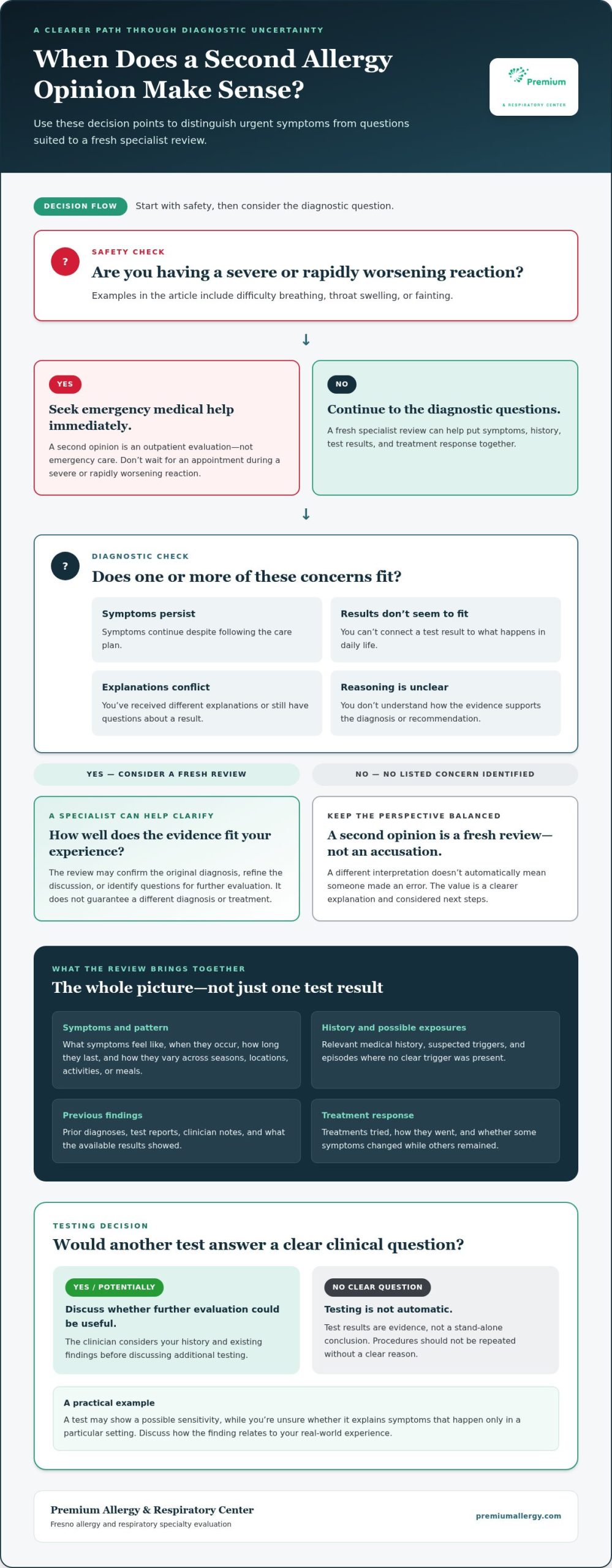
A second opinion is a fresh specialist review, not an accusation that your previous clinician was wrong. The goal is to consider the whole picture: what symptoms occur, when they happen, what exposures may be involved, what testing showed, and how treatment has gone so far. Allergy tests are one part of that picture. For an overview of allergy symptoms and diagnostic approaches, see Understanding Allergy Diagnosis.
You might consider another evaluation if you’ve received conflicting explanations, have unanswered questions about a result, or remain concerned that your plan isn’t addressing the problem. For example, a test may identify a possible sensitivity, but you may be unsure whether it explains symptoms that happen only in a particular setting. A specialist can discuss what the findings mean in context and what questions may need follow-up. A second opinion for allergy diagnosis Fresno patients seek may confirm the original diagnosis, refine the discussion, or identify areas for further evaluation. It doesn’t guarantee a different diagnosis or treatment.
Consider asking for a review if symptoms continue despite following your care plan, or if you can’t connect a test result to what happens in daily life. Another evaluation may also help if you don’t understand the reasoning behind a diagnosis or recommendation. Before your visit, write down what’s unclear, when symptoms occur, and what you’ve tried. These details give the discussion a practical starting point.
A specialist can review your history, previous findings, and testing together, then discuss how well the evidence fits your symptoms and what questions remain. The review may support the first diagnosis; a different interpretation doesn’t automatically mean someone made an error. The value is a clearer explanation and considered next steps, not a promised outcome.
Know when to seek urgent help. A second opinion is an outpatient evaluation, not emergency care. If you’re experiencing a severe or rapidly worsening reaction, such as difficulty breathing, throat swelling, or fainting, seek emergency medical help immediately rather than waiting for an appointment.
A second-opinion visit is a clinician-led review, not simply a repeat of your previous appointment. The specialist works to understand what prompted the original evaluation, what has changed, and which questions remain open. This broader view keeps the discussion focused on your experience, not just a test result.
Expect to discuss the pattern of your symptoms: what they feel like, when they occur, how long they last, and whether they change across seasons, locations, activities, or meals. Mention suspected triggers, but also describe episodes when no clear trigger was present. A brief timeline can make the pattern easier to explain.
The clinician may also review your medical history, previous diagnoses, relevant test reports, and treatments you’ve tried, including how you responded. If a care plan helped one symptom but not another, that difference can provide useful context. The specialist may ask follow-up questions to distinguish what the available information supports from what still needs clarification. Recommendations are based on your individual evaluation; no particular diagnosis or treatment outcome is guaranteed.
Existing results are evidence, not a stand-alone conclusion. Skin or blood tests may show a response to a specific allergen, but a specialist interprets that finding alongside your symptoms and history. If a result doesn’t match your real-world experience, discuss its relevance rather than assuming it automatically changes the diagnosis.
Further testing isn’t automatic. The clinician considers the question that needs answering, your history, and the findings already available before discussing whether another evaluation could be useful. For example, the next step may be to clarify how a reported exposure relates to a recurring symptom or to review what an earlier result can and can’t tell you. Each test decision should relate to a clinical question, rather than repeat procedures without a clear reason.
Bring the records you have, even if they feel incomplete. Prior reports and clinician notes can help the specialist understand what was tested, what the results showed, and how the original conclusion was reached. Premium Allergy & Respiratory Center provides comprehensive allergy evaluations, including blood allergy testing, for concerns involving allergic rhinitis, asthma, food allergies, and other allergic conditions. Its Fresno allergy testing guide offers additional context on the evaluation process.
If you’re seeking a second opinion for allergy diagnosis Fresno residents can use to clarify diagnostic questions, a focused specialty evaluation can help connect prior findings with your personal history. Learn more about allergy and respiratory care in Fresno.
When two evaluations sound different, it can be tempting to focus on which clinician is “right.” A more useful approach is to compare the reasoning behind each opinion. The goal isn’t to rank clinicians or seek a preferred answer. It’s to understand how your symptoms, history, and test findings support each conclusion, and what remains unclear.
Use this framework to organize the discussion. You can fill it in before or after the specialist visit using your records and notes:
| What to compare | Details to record |
|---|---|
| Original concern | Symptoms, suspected triggers, timing, and the question that led to the first evaluation |
| Prior evidence | Relevant history, test results, and observations considered in the original assessment |
| Specialist interpretation | How the new review connects the evidence with your symptoms and current concerns |
| Remaining questions | Points that are still uncertain, need clarification, or may affect the care plan |
Check whether both evaluations considered the same symptom pattern and medical history. Did each account for when symptoms occur, possible exposures, and changes over time? Note which test results informed each explanation. Then mark where the opinions align, differ, or leave a question open. A difference may reflect additional information, a different interpretation, or a question that needs more discussion. By itself, it doesn’t prove the earlier evaluation was mistaken.
Clear, neutral questions can turn conflicting recommendations into a more useful conversation. Consider asking:
Write down the answers in plain language and identify any points you’d like the clinicians involved in your care to clarify. If recommendations differ, ask what evidence or interpretation accounts for the difference rather than assuming one opinion cancels out the other. The aim is a clear, coordinated understanding of your options, not an instant verdict.
A second opinion for allergy diagnosis Fresno patients pursue is most useful when it connects the original concern, the evidence considered, and the next questions to address. Bring your comparison notes and focus on what each conclusion means for your situation.
A little preparation can help your appointment focus on the questions you most want answered. You don’t need a perfect medical file. Gather the information you have, note what’s been happening, and bring a short list of concerns so the clinician can consider your experience alongside your previous evaluation.
Use this sequence to get organized:
Prior reports can help the specialist see what was evaluated and how the earlier diagnosis was supported. Include a current medication list and any known reactions or side effects you want to discuss. Your symptom notes don’t need to be lengthy. A few dated examples, such as symptoms after a particular exposure or changes across settings, can make the pattern easier to describe.
Separate what you observed from what you suspect. For example, record the symptom and when it occurred, then note any possible exposure without assuming it caused the reaction. This gives the clinician useful context while leaving room to assess what the details mean. If some records aren’t available, bring what you have and identify what’s missing.
Writing questions down can help you use your appointment time well. Ask what evidence supports the current diagnosis, how it fits your symptom pattern, and what remains uncertain. You can also ask whether previous testing addresses the concern being reviewed and how any proposed next steps fit with your existing care plan.
These notes can help you take an active role without deciding in advance what the evaluation should conclude. Premium Allergy & Respiratory Center provides specialty allergy and respiratory evaluations for patients in Fresno, Clovis, Selma, and North Clovis. If you’re ready to discuss your concerns with a local specialist, explore allergy and respiratory care.
If your diagnosis or care plan still leaves questions, a local specialty evaluation can help put the pieces together. Premium Allergy & Respiratory Center is a Fresno-based allergy and respiratory specialty practice. Its clinicians provide comprehensive evaluations for diagnostic questions alongside care for allergic rhinitis, asthma, food allergies, and other allergic conditions.
A second opinion isn’t about pursuing a different answer at any cost. It’s an opportunity to discuss how your symptoms and history relate to previous findings, understand what the evidence does or doesn’t establish, and consider appropriate next steps. The result may reinforce an earlier assessment or clarify what needs further discussion. Recommendations depend on your individual evaluation.
Premium Allergy & Respiratory Center serves Fresno, Clovis, Selma, and North Clovis with outpatient allergy and respiratory diagnostic and treatment services. A specialty evaluation can address questions related to allergic rhinitis, asthma, food allergies, and other allergic conditions, connecting the concern that brought you in with the information available. If ongoing nasal symptoms are part of your concern, the allergic rhinitis specialist guide offers more context on focused care for those symptoms.
This is outpatient specialty care, not emergency services or general primary care. For urgent or severe symptoms, seek emergency medical help rather than waiting for an outpatient evaluation.
Before your evaluation, gather prior results and notes and write down the main questions you want answered. A short list can help you explain what remains uncertain and keep the discussion centered on your concerns. If asthma is part of the picture, the asthma management plan guide can help you explore how an organized care plan supports ongoing conversations about respiratory health.
For people seeking a second opinion for allergy diagnosis Fresno specialists can provide, a thoughtful review can be a constructive step toward understanding your diagnostic picture. Explore specialty allergy and respiratory care and bring your questions and previous findings into the conversation.
You don’t need to arrive at your next appointment with a diagnosis already decided. Start with what you want to understand better. A productive discussion can help identify which concerns deserve attention, what questions remain open, and how to approach next steps thoughtfully. Clarity may come from a new interpretation, confirmation of what you’ve already been told, or a better understanding of why further evaluation may be considered.
If you’re considering a second opinion for allergy diagnosis Fresno, use your questions to start a conversation centered on your needs. You deserve to understand the reasoning behind your care and feel prepared to take part in decisions about it. Explore specialty allergy and respiratory care in Fresno with Premium Allergy & Respiratory Center to discuss your concerns with a local specialist.
It may be worthwhile if symptoms continue, test findings are hard to interpret, or you’re unsure why a diagnosis or care plan was recommended. A second opinion for allergy diagnosis Fresno patients seek offers another opportunity to discuss how the evidence fits their experience. For example, you can ask what a result means for symptoms that occur in a particular setting. The goal is clearer understanding, not a guaranteed change in diagnosis or treatment.
Yes. Bring the full report if you have it, rather than relying only on a summary or recollection. Tell the specialist what symptoms or concerns prompted the original testing, and note whether your symptoms have changed since then. This context helps the clinician assess the report alongside your history. If a result is missing details or difficult to interpret, ask what information can reasonably be drawn from the available record.
Not necessarily. A specialist may first review your existing reports and consider whether they address the concern you want evaluated. If further testing is discussed, ask what specific question it could help answer and how the result might inform care. You can also ask whether the previous report contains enough detail for review. The decision depends on your individual situation, so a second opinion doesn’t automatically mean another test.
Bring available allergy test reports, relevant diagnosis notes, and a current list of medications, including how you take them. A brief symptom log can add useful detail: record the date, what you noticed, where you were, and any possible exposure. Include changes you’ve observed, such as symptoms becoming more frequent or appearing in a new setting. Write down your main questions so you can refer to them during the visit.
Yes. Premium Allergy & Respiratory Center serves patients in Fresno, Clovis, Selma, and North Clovis. Before an outpatient specialty evaluation, gather the records you have and identify the part of your diagnosis or care plan you’d like reviewed. If you’re experiencing a sudden or severe reaction, don’t wait for a scheduled visit. Seek emergency care instead, since the practice provides outpatient allergy and respiratory specialty care.
No. Don’t stop or change prescribed medication on your own to prepare for an appointment. Preparation can depend on the medication and the evaluation being considered, so ask the clinician for instructions that apply to you. Bring the medication name, dose, and timing, and note any effects or concerns you’ve noticed. If your care team has already provided preparation instructions, follow them unless a clinician advises you otherwise.
Ask both clinicians to explain the reasoning behind their views, including which findings support each interpretation and how they relate to your symptoms. A difference doesn’t automatically mean the first assessment was wrong; the clinicians may weigh evidence differently or address different questions. Ask what is established, what remains uncertain, and how to discuss the recommendations together before making changes to your care plan.
Could another allergy evaluation clarify why your symptoms persist, rather than simply repeat the same tests? If you’re searching “second opinion for... Continue reading
READ MORE
What if recurring wheezing, coughing, or chest tightness could help point the way to a clearer asthma plan? If you’re searching for an asthma... Continue reading
READ MORE
For families exploring EoE diet management Selma, the safest first step may be replacing guesswork with a monitored plan, not cutting out more foods.... Continue reading
READ MORE
Are allergy symptoms disrupting your sleep, daily routine, or breathing while you wonder whether you can be seen today? A same day allergy... Continue reading
READ MORE