
What if recurring wheezing, coughing, or chest tightness could help point the way to a clearer asthma plan? If you’re searching for an asthma... Continue reading
READ MORE

For families exploring EoE diet management Selma, the safest first step may be replacing guesswork with a monitored plan, not cutting out more foods. It’s understandable to wonder which foods might contribute to inflammation, whether restrictions could affect nutrition, and what symptoms or allergy tests can tell you. Standard skin or blood IgE allergy tests alone cannot reliably identify EoE food triggers.
Dietary changes can be part of EoE care, but they work best with clinical guidance, thoughtful meal planning, and follow-up. Endoscopy with biopsy is used to assess inflammation, so symptoms alone may not show whether a diet change is working. A registered dietitian can help protect nutritional balance while foods are removed and reintroduced.
This guide explains how elimination approaches work, why monitoring matters, and what to discuss with your care team. If you’re also concerned about food allergies, Premium Allergy & Respiratory Center provides food allergy testing and personalized care for allergic conditions in Selma and nearby communities. Allergy-focused evaluation can help address coexisting concerns, but allergy tests are not a shortcut to identifying EoE triggers.
Before removing foods from your meals or your child’s plate, start with what the condition means. Eosinophilic esophagitis (EoE) is a chronic inflammatory condition affecting the esophagus, the tube that carries food from the mouth to the stomach. Eosinophils are a type of white blood cell involved in immune responses. In EoE, these cells build up in the esophageal lining and contribute to inflammation, which can make swallowing difficult.
A concise definition: EoE is a chronic immune-related disease in which eosinophils cause inflammation in the esophagus. Food may be one factor involved, but diet is not the only treatment approach. A clinician can help select other medical options as appropriate. This Eosinophilic Esophagitis (EoE) overview offers additional background on symptoms, diagnosis, and treatment approaches.
Experiences vary. Some people have trouble swallowing or feel that food gets stuck; others take unusually small bites, chew for a long time, or avoid certain textures to make meals easier. Children may show feeding challenges, such as reluctance to eat or difficulty managing foods. These patterns can be stressful, but they don’t point to one specific trigger food. Similar symptoms can have different causes, so food-related conclusions need clinical context.
EoE-related inflammation also differs from a typical immediate food-allergy reaction. An IgE-mediated allergy can cause a rapid reaction after exposure, while EoE involves inflammation in the esophagus and requires a different evaluation. A person can have EoE, a separate food allergy, both, or neither. Avoiding a food because of an immediate allergy concern is not the same as identifying an EoE trigger. Standard skin or blood IgE allergy tests shouldn’t be used alone to determine which foods drive EoE. For people considering EoE diet management in Selma, restrictions should match the clinical question, not a guess based on symptoms or a test result alone.
Diagnosis involves a clinician’s assessment alongside findings from an upper endoscopy and biopsies, small tissue samples taken from the esophagus. Symptoms are important to discuss, but feeling better after a food change doesn’t prove that inflammation has resolved. Inflammation may not track perfectly with how swallowing feels, so clinicians use appropriate follow-up assessment to evaluate the esophagus.
This section is general education, not an individual diagnosis or treatment plan. Don’t begin a broad elimination diet or make lasting food restrictions based only on this information. A clinician can help interpret symptoms and biopsy findings, discuss suitable treatment choices, and consider nutritional needs. With appropriate assessment, food decisions can become more deliberate and less overwhelming.
An elimination diet is a structured trial: selected foods are removed for a planned period, then the care team reassesses whether the approach is helping. It isn’t a permanent restriction to start on your own or continue indefinitely without review. The plan’s scope depends on clinical circumstances, nutritional needs, daily routines, and what the patient and care team can manage.
EoE diet trials need planned reassessment, not symptom tracking alone. Symptoms can offer useful clues, but they can’t confirm whether inflammation has changed. The American Gastroenterological Association (AGA) guidelines for EoE discuss dietary therapy as one management approach, with decisions and follow-up shaped by the clinical picture. A planned review helps keep a food trial purposeful rather than turning it into open-ended food avoidance.
As one example, the Australasian Society of Clinical Immunology and Allergy (ASCIA) guide describes a supervised approach that removes cow’s milk and wheat. That guide gives an 8-to-12-week trial period. It’s specific to its resource, not a universal timeline or instruction for every patient. Whether this narrower starting point fits depends on individual circumstances and clinician guidance.
Even a short list of excluded foods takes planning. Milk and wheat can appear in packaged foods under different ingredient names, and suitable alternatives vary. Read ingredient labels carefully, consider how meals will stay balanced, and discuss practical barriers before starting. A dietitian can help with meal planning and nutritional adequacy, especially when a child’s growth or a limited range of accepted foods is a concern.
Removal is only one stage. If the care team recommends it, foods may be reintroduced in a planned sequence so the response to each change can be assessed. Don’t improvise the sequence or timing. The clinician’s plan should account for the person’s health history, treatment choices, and how inflammation will be evaluated.
Follow-up may include clinical assessment and, when appropriate, endoscopy with biopsy to check the esophagus. Symptom notes can help explain changes in swallowing or eating, but they don’t replace assessment of inflammation. A person might feel better without knowing whether tissue inflammation has improved, or still have symptoms for reasons that need further discussion. The care team can determine what reassessment is appropriate; this guide can’t set an individual schedule.
For EoE diet management in Selma, agree on the trial’s foods, duration, nutrition plan, and reassessment process before making changes. If you also have questions about a separate food allergy, food allergy testing and allergy-focused care can address those concerns without using allergy tests alone to identify EoE trigger foods.
There isn’t one elimination plan that fits everyone. A narrower approach removes fewer foods and may be easier to fit into family meals, shopping, and social routines. A broader plan excludes more foods, which can make meal planning and maintaining nutritional variety more demanding. A clinician may consider starting with fewer restrictions, then adjusting the approach based on the person’s circumstances and follow-up findings.
Think beyond the number of foods on the list. Consider what the person already eats, whether suitable alternatives are practical, and how restrictions may affect school, work, family meals, or enjoyment of food. These details help the care team weigh quality of life and nutritional planning alongside clinical goals. A less restrictive start may suit some situations, but it isn’t automatically the most effective choice for every patient.
The table offers a general comparison, not a recommendation. Any approach needs a clear plan for monitoring and reassessment.
| Approach | Breadth and practical burden | Planning and monitoring |
|---|---|---|
| Narrower elimination | Fewer foods are excluded, which may be easier to manage day to day. | Still requires balanced substitutions, label awareness, and clinician-guided follow-up. |
| Broader elimination | More foods are excluded, potentially affecting more meals and routines. | May need more extensive nutrition planning and careful follow-up to assess the response. |
Neither approach guarantees a particular result. Judge a food plan by the agreed clinical goals and appropriate assessment, not by how restrictive it looks or whether symptoms seem different. Inflammation may not match how a person feels, so symptom notes can inform a discussion but can’t establish on their own whether the esophagus has improved. Clarify how the plan will be reviewed before restrictions begin.
Tests for immediate, IgE-mediated food allergies address a different clinical question from identifying foods involved in EoE. Skin or blood allergy tests don’t reliably identify EoE trigger foods on their own, so their results shouldn’t be used as a stand-alone elimination list. Allergy-focused evaluation may still help when there are separate concerns about immediate reactions or a coexisting food allergy.
Keep the next step focused: use EoE assessment to guide EoE diet decisions, and evaluate possible food allergies as a separate concern when clinically appropriate. For people in Selma with questions about allergy evaluation, the food allergy clinic guide explains how food allergy testing can support allergy-related care without serving as an EoE trigger checklist.
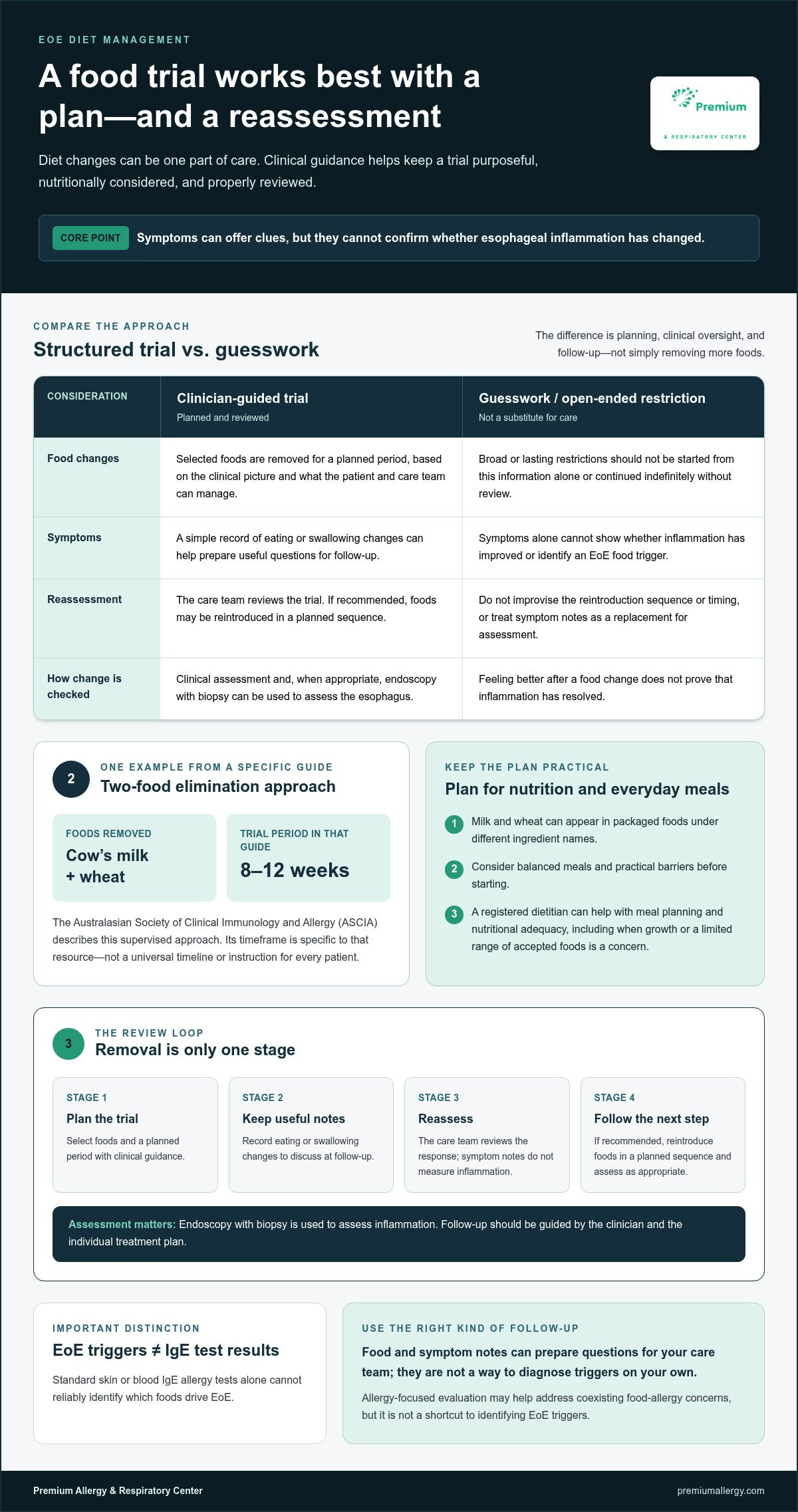
A food trial is easier to manage when practical details are planned before restrictions begin. Work with the treating clinician to understand which foods are part of the trial, what alternatives may fit, and how progress will be reviewed. Don’t start a restrictive diet or make lasting changes based only on a symptom diary or online guidance.
Before making changes, write down the foods and meals that are already part of your routine. This gives you and your care team a useful starting point and helps identify where substitutions may be needed. Consider school or work meals, family preferences, cultural foods, budget, and other dietary needs that could affect planning.
Thoughtful substitutions can help keep meals satisfying instead of narrowing them unnecessarily. For example, if a familiar breakfast relies on an ingredient being removed, discuss an appropriate alternative before the trial starts. The right substitute depends on the person’s needs and the specific plan, so don’t assume one replacement works for everyone.
A simple diary can help you share clear observations at follow-up. Keep it consistent and brief; it doesn’t need to become a detailed analysis of every meal. Record what was eaten, any suspected accidental exposure, symptoms and when they occurred, and questions you want to raise. Note changes in routine too, such as a skipped meal or a newly tried food.
Use the record to guide discussion, not to prove a trigger. Symptoms can fluctuate, and feeling better is useful information, but it can’t confirm that esophageal inflammation has resolved or replace clinical reassessment. Bring the record to follow-up so the care team can consider it alongside the broader plan.
If you have separate concerns about immediate food-allergy reactions, the food allergy clinic guide explains allergy evaluation and safety. For allergy-related concerns in Selma, Fresno, Clovis, and North Clovis, explore food allergy testing and personalized allergy care at Premium Allergy & Respiratory Center. These services address food-allergy questions, not EoE-specific diet management.
Questions about food triggers can overlap with questions about a separate food allergy. For people seeking EoE diet management in Selma, keeping those concerns distinct can make the next step clearer. Premium Allergy & Respiratory Center provides specialty allergy and respiratory care for Selma and nearby communities, including Fresno, Clovis, and North Clovis. Its food allergy testing and personalized allergy care address coexisting allergy-related concerns, while EoE diagnosis and diet decisions remain part of the person’s broader clinical care.
A little preparation can help you explain what you’re experiencing and focus the conversation. Bring concise notes rather than trying to remember every detail on the spot. Useful information may include:
These details can support an allergy-focused discussion. They don’t establish an EoE diagnosis, and allergy testing shouldn’t be treated as a stand-alone way to identify foods involved in EoE. If you’re already working with clinicians on EoE, share relevant information with your care team so each part of your care can be considered in context.
EoE care may involve coordination among clinicians, depending on individual needs. Allergy evaluation can be useful when there are separate concerns about coexisting food allergies or other allergic conditions. It serves a different purpose from monitoring inflammation in the esophagus, so it shouldn’t replace the follow-up plan for EoE.
If asthma is also part of your health picture, the asthma management plan guide offers information relevant to that coexisting condition. Keeping notes on each concern can help make conversations with your care team more focused, without assuming that one condition explains another.
You don’t have to sort through every food or symptom question alone. For allergy-related concerns in Selma and nearby Fresno-area communities, Premium Allergy & Respiratory Center provides food allergy testing and specialty allergy and respiratory care. Bring your questions and existing records to help make the conversation more focused.
A thoughtful next move doesn’t require identifying every trigger on your own. Start by noting the questions that remain, such as how an allergy concern fits alongside your existing care plan or what information would make your next discussion more useful. Share those questions with the clinicians involved in your care, and keep EoE decisions connected to appropriate clinical assessment.
If you have a concern about a separate food allergy or another allergic condition, an allergy-focused conversation can help you explore that part of your health picture. Premium Allergy & Respiratory Center provides specialty allergy and respiratory care for the Selma area, including food allergy testing and personalized care for allergic conditions. These services support allergy-related questions and don’t replace EoE diagnosis or management.
For EoE diet management in Selma, the goal is a next step grounded in your needs rather than guesswork. Explore allergy and respiratory care serving Selma and take a confident step toward clearer answers about your allergy concerns.
No. EoE is a chronic condition involving inflammation in the esophagus, while familiar food allergies often cause symptoms soon after exposure. Food may be involved in both, so the conditions can coexist. If a reaction includes hives, swelling, wheezing, or sudden vomiting, note the timing and circumstances for a clinician. Describe persistent swallowing concerns separately as well. Neither pattern alone confirms the cause; share your history so each concern can be assessed appropriately.
No. Allergy testing doesn’t reliably identify EoE triggers by itself. A positive skin or blood test may show sensitization, but it doesn’t establish that a food is driving esophageal inflammation. Testing may still help if your history suggests a separate immediate food allergy. Describe what happened, how soon symptoms began, and what you ate. Premium Allergy & Respiratory Center provides food allergy testing for allergy-related concerns in Fresno, Clovis, Selma, and North Clovis.
There isn’t one duration that applies to every person or plan. ASCIA’s guide describes an 8-to-12-week trial for its specific two-food approach, but that example isn’t a universal schedule. Before starting, discuss the review point for your plan and how to handle food changes until then with your treating clinician. If life disrupts the trial, don’t extend it automatically; discuss the next step with the clinician overseeing your care.
Discuss a restrictive diet with your treating clinician before starting. Removing foods without a plan can make it harder to maintain a varied diet and understand what a change means. This matters especially for children, people already avoiding several foods, or anyone concerned about nutrition or growth. While preparing for a discussion, write down your usual meals, existing restrictions, and questions rather than removing additional foods on your own.
Tell the clinician managing your care, but don’t assume improvement confirms that inflammation has resolved. Swallowing might feel easier while the care team still needs to assess whether the treatment plan is working as intended. Keep following the agreed plan until you’ve discussed the change. Don’t reintroduce foods or stop prescribed treatment based only on how you feel; ask what follow-up assessment is appropriate for your situation.
Yes. Dietary elimination is one possible approach, not the only option clinicians may discuss. The right plan depends on your health history, preferences, and practical needs, including whether restrictions are manageable for your household. Ask your care team what alternatives may fit and how progress would be evaluated. People seeking EoE diet management information in Selma can use that conversation to weigh nutrition, daily routines, and clinical goals without making treatment changes based only on online guidance.
What if recurring wheezing, coughing, or chest tightness could help point the way to a clearer asthma plan? If you’re searching for an asthma... Continue reading
READ MORE
For families exploring EoE diet management Selma, the safest first step may be replacing guesswork with a monitored plan, not cutting out more foods.... Continue reading
READ MORE
Are allergy symptoms disrupting your sleep, daily routine, or breathing while you wonder whether you can be seen today? A same day allergy... Continue reading
READ MORE
Could your baby’s dry, itchy rash be eczema, or is something else making their skin uncomfortable? When redness keeps returning or disrupts sleep,... Continue reading
READ MORE