
Could your baby’s dry, itchy rash be eczema, or is something else making their skin uncomfortable? When redness keeps returning or disrupts sleep,... Continue reading
READ MORE

Could your baby’s dry, itchy rash be eczema, or is something else making their skin uncomfortable? When redness keeps returning or disrupts sleep, it’s natural to wonder whether a new product, a food, or another trigger is involved. If you’re looking for eczema care for infants Clovis families can turn to, start with a calm, practical approach: protect your baby’s skin barrier without assuming every flare is an allergy.
You can learn to recognize common eczema patterns, but a rash’s appearance alone can’t confirm the cause. This guide covers what infant eczema may look and feel like, how to build a gentle bathing and moisturizing routine, and why you shouldn’t change your baby’s diet or pursue allergy testing based on a guess.
It also explains when an individualized evaluation may help. Premium Allergy & Respiratory Center provides atopic dermatitis care for families in Clovis and nearby communities, with attention to each child’s overall clinical picture. Clear guidance can help you feel more prepared to care for your baby’s skin and know when specialist support may be useful.
Eczema, also called atopic dermatitis, is an inflammatory skin condition that can leave an infant’s skin dry, itchy, and irritated. Several skin conditions can look similar, and eczema can look different from one child to another. A rash’s appearance alone can’t confirm what’s causing it.
Eczema describes a pattern of itchy, inflamed skin; a confirmed diagnosis requires a clinician to assess the child’s symptoms and overall clinical picture. Noticing a possible pattern is useful, but it isn’t the same as identifying the condition or its cause. For a broad overview of atopic dermatitis (eczema), see the condition’s symptoms and background alongside guidance from your child’s clinician.
Infant eczema may show up as dry, rough, red, or otherwise inflamed patches. The cheeks and scalp are possible locations, but affected areas vary. A patch may look more noticeable during a flare and less inflamed at another time. Skin tone can also affect how redness appears, so irritation may not look the same on every baby.
Instead of trying to diagnose from a picture or a single flare, note where the rash appears, whether your baby seems itchy or unsettled, and how the skin changes over time. If symptoms persist or keep returning, share those observations with a clinician. This context can help distinguish eczema from other possible causes of a rash.
The skin barrier is the outer layer that helps hold moisture in and protect skin from irritants. When that barrier is weakened, moisture can escape more easily, leaving skin dry and more sensitive. Irritation may contribute to itching and inflammation, making a flare uncomfortable. Eczema can involve several influences, so there isn’t one trigger that explains every infant’s symptoms.
Eczema is not contagious; your baby can’t catch it from another person or pass it to someone else. If you’re looking for eczema care for infants Clovis families can access, an individualized assessment can help clarify whether the symptoms fit atopic dermatitis and what support is appropriate. Observing the pattern is a useful first step, not a substitute for clinical evaluation.
A flare can follow a change in routine, but that doesn’t prove the change caused it. Infant eczema may reflect several influences, including a sensitive skin barrier and environmental irritants. A food or household exposure isn’t automatically the explanation. Removing multiple things at once can make patterns harder to understand, so start with careful observation rather than a long list of restrictions.
A suspected trigger is a clue to discuss, not proof of an allergy; only an appropriate clinical evaluation can establish whether an allergy is part of your baby’s picture. This can ease the pressure to identify one culprit right away and help you avoid unnecessary diet changes or testing based on timing alone.
When a flare appears, keep a simple record of the date, where the irritation showed up, products used on your baby or their clothes, and noticeable environmental changes. Fragranced soaps or detergents and rough fabrics may irritate some infants’ skin. Heat or a sudden temperature change may also be worth noting if symptoms seem to follow that pattern.
Look for repetition rather than drawing conclusions from one occasion. If a new detergent was used before a flare, record the timing, but don’t treat it as proof of a cause. Keep observations brief and consistent. Unless a clinician advises otherwise, avoid changing several products or exposures at the same time, so it’s easier to see what may matter.
An allergy specialist considers your baby’s history and symptoms together before deciding whether allergy evaluation is relevant. Eczema alone doesn’t mean an infant has a food or environmental allergy, and routine testing isn’t needed for every baby with eczema. A careful assessment can help distinguish a possible association from a finding that warrants further evaluation.
Bring your notes and questions to an appointment, especially if you’ve noticed a consistent relationship between a particular exposure and symptoms. For a broader overview of care options, Premium Allergy & Respiratory Center’s atopic dermatitis medical treatment guide explains why management should be tailored rather than based on assumptions. The American Academy of Pediatrics guidance on eczema care also offers practical information for families.
Premium Allergy & Respiratory Center provides individualized outpatient atopic dermatitis evaluation for families seeking eczema care for infants Clovis. The evaluation considers each child’s overall clinical picture. Learn about specialty atopic dermatitis care and the support available for your baby’s needs.
No. Eczema by itself does not prove that your infant has a food allergy or an environmental allergy. These conditions can occur in the same child, but an association is not a diagnosis. A rash alone can’t establish that a particular food, pet, or other exposure is responsible.
Eczema is a skin condition; an allergy is a separate diagnosis that requires its own clinical assessment. Keeping that distinction in mind can help you respond thoughtfully instead of making major changes based on worry or guesswork.
It may be tempting to remove foods from your baby’s diet or seek broad testing as soon as eczema appears. But eczema alone doesn’t identify which, if any, allergen is relevant. Restricting foods without clinical guidance can make feeding choices more complicated and distract from understanding the skin symptoms. Allergy testing based solely on eczema may also produce results that don’t explain what’s happening for your child. Testing is most useful when it addresses a specific question raised by the child’s history and symptoms.
A clinician may consider eczema alongside other symptoms, your baby’s health history, and family context, including a history of allergic conditions. That broader picture can inform the assessment, but it doesn’t mean your infant will develop another allergic condition. Eczema varies from child to child, and family history is one part of the story, not a prediction.
If you’ve noticed symptoms beyond the rash, describe what happened, when it occurred, and whether you saw a repeatable connection to a particular exposure. Separate what you observed from what you suspect: “the rash appeared after a meal” is useful context, while “the meal caused an allergy” is a conclusion that still needs evaluation.
A specialist can review the details and decide whether the eczema and any additional symptoms suggest an allergy question worth exploring. The next step depends on the individual child, not on a rule that every infant with eczema needs testing. This targeted approach keeps evaluation relevant and avoids treating an uncertain trigger as established fact.
Before an appointment, consider bringing a concise history of the rash, any other symptoms, family context, and the specific concern you want addressed. Photos taken during a flare may also help show how the skin changes over time. These details support a focused conversation about whether further evaluation is appropriate.
Premium Allergy & Respiratory Center provides outpatient atopic dermatitis care for families seeking eczema care for infants Clovis. The clinic considers each child’s overall clinical picture rather than assuming eczema automatically signals an allergy or that every baby needs allergy testing.
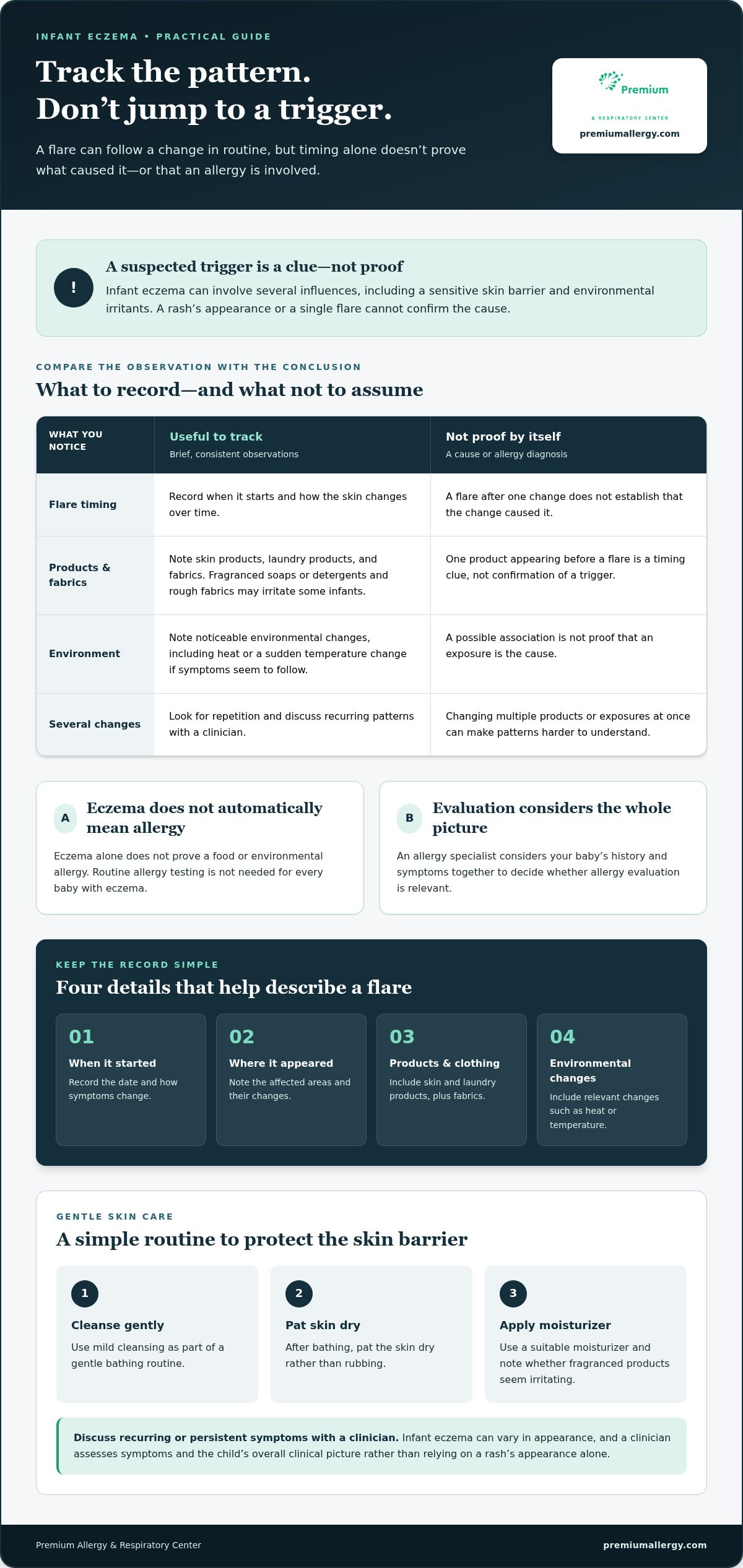
A straightforward routine can make daily skin care more manageable. Keep the steps gentle and consistent, and watch how your baby’s skin responds. A basic sequence is to cleanse, pat dry, and moisturize. Use a suitable product for your infant, and avoid fragranced products if they seem to irritate the skin.
Introducing several new products at once makes it harder to tell how your baby’s skin is responding. Keep the routine steady where possible, and note whether a product seems to coincide with irritation. If you’re unsure which moisturizer or cleanser is suitable, ask a clinician for guidance. The American Academy of Pediatrics guidance on eczema care can also help you understand general care approaches.
Medication is a separate part of care. Don’t start, stop, or change a medicine for an infant without clinician guidance. The appropriate choice and use depend on the child and the symptoms being treated.
Arrange a clinical evaluation if symptoms persist, keep worsening, return often, or disturb your baby’s sleep. A clinician can assess the skin and consider whether the current care plan needs adjustment. You don’t have to wait until symptoms feel unmanageable to ask for help.
Some changes call for more prompt attention. Increasing pain, redness that spreads, or drainage from affected skin may signal a complication and should be discussed with a clinician promptly. Seek urgent medical care if your baby’s symptoms are severe or worsening rapidly.
Premium Allergy & Respiratory Center provides individualized outpatient atopic dermatitis evaluation for families seeking eczema care for infants Clovis. A specialist considers your child’s overall clinical picture and helps guide next steps. Explore personalized atopic dermatitis care for support with your infant’s skin concerns.
It can be hard to know whether a flare is part of an expected pattern or a reason to seek more support. Consider specialty evaluation if your baby’s symptoms keep returning, persist despite a gentle routine, or are difficult to manage day to day. Ongoing itch that interrupts sleep or uncertainty about caring for your infant’s skin also deserves attention. You don’t need to wait until symptoms feel severe to ask for an individualized assessment.
Specialty care can bring clearer direction when repeated flares raise questions about the diagnosis, possible contributing factors, or next steps. An evaluation doesn’t mean your baby automatically needs allergy testing or a particular treatment. It provides an opportunity to review what’s happening and consider care suited to your child.
A clinician can review your infant’s symptoms, health history, and the patterns you’ve observed, including changes over time and how symptoms affect sleep or daily care. Bringing notes or photos of flares can help communicate what you’ve noticed. Together, these details may help clarify whether the symptoms fit atopic dermatitis and what questions should guide the care plan.
Recommendations depend on your baby’s individual needs. The goal is a thoughtful management plan, not a guaranteed result or a one-size-fits-all answer.
Premium Allergy & Respiratory Center provides outpatient allergy and respiratory specialty care, including atopic dermatitis care. The clinic serves families in Clovis, Fresno, Selma, and North Clovis. An allergy specialist can consider your infant’s skin concerns within their overall clinical picture, helping distinguish what is known from what still needs assessment.
Before an evaluation, write down what you want addressed and bring a brief record of recurring symptoms, products used, and changes you’ve noticed. Share concerns about sleep or difficulties maintaining a routine, too. These details can make the conversation more focused and help your clinician understand how symptoms affect your family.
For families exploring eczema care for infants Clovis can access, Premium Allergy & Respiratory Center offers individualized outpatient evaluation and management for atopic dermatitis. Explore atopic dermatitis specialty care and take the next step toward support for your family.
Your baby’s skin needs may change over time, so think of care as an ongoing conversation rather than a problem you must solve all at once. Bring your observations and questions to a clinician and work toward a plan that fits your infant’s needs. Seeking guidance is a thoughtful step, not a sign that you’ve done anything wrong.
Premium Allergy & Respiratory Center provides specialty outpatient care for atopic dermatitis for families considering eczema care for infants Clovis. The clinic serves Clovis, Fresno, Selma, and North Clovis. An individualized evaluation can put your concerns in context and guide a considered next step without assuming a particular trigger or outcome.
Ready to explore support for your baby’s skin concerns? Explore personalized atopic dermatitis care with Premium Allergy & Respiratory Center.
No. Eczema can’t be passed from one person to another through touch, so you don’t need to keep your baby apart from family members because of eczema. It can cause dry, itchy, inflamed skin, with symptoms that may come and go. Since other conditions can look like eczema, have a clinician assess a rash that persists, worsens, or causes your baby considerable discomfort.
Eczema alone doesn’t establish that your baby has a food allergy. If you notice symptoms that seem to follow a particular food, write down what happened and share the details with a qualified clinician. Don’t remove foods from your baby’s diet or your diet while breastfeeding based only on a rash. Discuss the timing, symptoms, and any suspected connection before making dietary changes.
It may appear as dry, red, itchy, or inflamed patches, including on the cheeks, but facial rashes vary and can have other causes. A photo can help you show a clinician how the area changes, but it can’t confirm a diagnosis. Note whether the rash is spreading, seems painful, or comes with other concerning symptoms, and seek clinical guidance if it persists or worsens.
Some children’s eczema improves as they grow, but no one can predict that course for an individual infant. Symptoms may also return, so a period of clearer skin doesn’t necessarily mean the condition will never flare again. Keep following the care guidance made for your baby, and ask a clinician before stopping a recommended treatment or if symptoms return and become difficult to manage.
The right moisturizing routine can vary by baby and by how their skin responds. Many care plans include moisturizer after bathing, but your clinician can advise on a suitable product and frequency for your infant. If fragrance seems irritating, choose a fragrance-free option. Stop using a product that appears to sting or worsen the rash, and seek guidance about what to try next.
Don’t start hydrocortisone or another medicated cream for your infant without guidance from a qualified clinician. Whether it’s appropriate can depend on your baby’s age, the affected area, and the symptoms. Ask for clear instructions on where to apply it and for how long. Avoid using an adult product or leftover prescription cream unless a clinician specifically advises you to use it for your baby.
Arrange clinical guidance if symptoms persist, worsen, disrupt sleep, or remain difficult to manage with gentle care. Increasing pain, spreading redness, or drainage should be assessed promptly; seek urgent medical care if symptoms are severe or rapidly worsening. For ongoing concerns, eczema care for infants Clovis families can access includes outpatient atopic dermatitis care at Premium Allergy & Respiratory Center, serving Clovis, Fresno, Selma, and North Clovis.
Could your baby’s dry, itchy rash be eczema, or is something else making their skin uncomfortable? When redness keeps returning or disrupts sleep,... Continue reading
READ MORE
If you’re searching for an “asthma doctor for kids Selma CA,” recurring cough, wheezing, or shortness of breath can leave you wondering whether your... Continue reading
READ MORE
Could recurring congestion, itchy skin, coughing, or reactions to food point to an allergy, or could something else be causing your child’s symptoms?... Continue reading
READ MORE
What if your spring allergies aren’t just bad luck, but a sign that your current plan is missing important triggers? In Fresno, oak, mulberry, and... Continue reading
READ MORE