
If you’re searching for an “asthma doctor for kids Selma CA,” recurring cough, wheezing, or shortness of breath can leave you wondering whether your... Continue reading
READ MORE

Could recurring congestion, itchy skin, coughing, or reactions to food point to an allergy, or could something else be causing your child’s symptoms? If you’re searching for a child allergy specialist Clovis families can access, start by looking for care that considers the symptom pattern and your child’s health history before recommending testing or treatment. That approach can help you understand what a specialist can evaluate and what to expect next.
An allergy evaluation may include a discussion of symptoms, possible triggers, and health history, followed by an exam. Testing or a care plan may be considered based on what the clinician learns; not every child needs the same approach. Bringing a clear account of what you’ve noticed can make the visit more focused.
This guide explains when specialty care may help, what an evaluation can involve, and what information and questions to bring. Premium Allergy & Respiratory Center is based in Fresno and serves families in Clovis and nearby communities, including Selma and North Clovis. The practice provides specialty evaluation and management for allergic and respiratory conditions.
Recurring symptoms don’t automatically mean your child has an allergy. If symptoms keep returning, disrupt sleep, or make school and everyday activities harder, an evaluation may help clarify what’s going on. Families in Clovis may seek specialty input for ongoing nasal symptoms, breathing concerns, skin irritation, or reactions associated with food. The timing and circumstances of symptoms, along with your child’s health history, matter more than any single sign.
An allergy specialist evaluates symptoms and health history to determine whether an allergic condition may be involved and to guide appropriate testing and management. A focused assessment can help families move from guesswork toward clearer next steps. For a general overview of symptoms and possible approaches, see Allergies in children. A clinician can assess how an individual child’s experience fits.
Consider discussing symptoms with a clinician if they persist, return in particular settings or seasons, or interfere with your child’s comfort and routine. Examples include a frequently stuffy or runny nose, sneezing, itchy or watery eyes, coughing, wheezing, recurring itchy or inflamed skin, or symptoms after eating a particular food. These signs can have causes other than allergies, so treat them as clues to discuss, not as a diagnosis.
Allergic rhinitis, asthma, food allergy, and atopic dermatitis are among the conditions evaluated or managed in allergy specialty care. A symptom diary can help you describe patterns: note when symptoms occur, what your child was doing or exposed to, how long they lasted, and whether they affected sleep or activities. You don’t need to identify the cause on your own before seeking guidance.
Families may seek a focused evaluation when symptoms remain difficult to understand, recur despite steps already taken, or raise questions about possible triggers and management. Specialty care complements routine primary care; it doesn’t replace it. A clinician can consider your child’s history and symptoms to decide whether allergy assessment is appropriate and whether testing or an individualized management plan may be useful.
If your child has severe symptoms or a potentially life-threatening reaction, seek emergency services immediately rather than waiting for a specialty appointment. For non-emergency concerns, choosing a child allergy specialist Clovis families can access may be a practical next step when recurring symptoms deserve a more focused assessment.
An allergy evaluation is a step-by-step conversation, not an automatic decision to test. The clinician considers what your child is experiencing, how symptoms have changed over time, and whether the pattern suggests that an allergy assessment could be useful. Knowing the general sequence can make a visit feel more manageable and help you focus on the questions that matter most.
There’s no single assessment that fits every child. The method depends on symptoms and medical history, and testing isn’t automatically needed just because a child has a rash, cough, or stuffy nose. If you’re looking for a child allergy specialist Clovis families can access, expect the evaluation to focus on your child’s individual situation rather than a one-size-fits-all checklist.
A clear timeline makes patterns easier to discuss. Note when symptoms began, how often they happen, how long they last, and whether they affect sleep, school, meals, or play. Include possible exposures, such as particular foods or environments, without assuming they are the cause. Bring medication details, relevant health records, and previous test results if available. Write down your questions, too.
It may help to describe a specific episode in sequence: what your child was doing, what symptoms appeared, and what happened afterward. Mention if symptoms seem to change by season, location, activity, or meal. Even details that seem unrelated can help the clinician understand the context and decide what deserves closer assessment.
Testing is one part of an assessment, not a stand-alone diagnosis. Results need to be understood alongside symptoms and health history, since a test finding by itself may not explain what a child experiences. Allergy test results are interpreted alongside clinical history to help assess whether a suspected allergen fits the child’s real-world symptoms.
Premium Allergy & Respiratory Center offers blood allergy testing as part of its specialty diagnostic services. Whether testing is useful, and which assessment method is suitable, depends on the clinical evaluation. Learn more about the practice’s allergy and respiratory specialty care serving Clovis. An evaluation may lead to testing, further discussion, or a management plan, depending on the child’s needs.
A directory can help you find practices, but it may not explain how each one approaches a child’s concerns. Compare practical fit: whether the specialty scope relates to the symptoms, whether the evaluation considers the child’s history, and whether the location and ongoing care work for your family. A clear explanation of the process is more useful than a ranking alone.
| What to compare | Questions to consider | Why it matters |
|---|---|---|
| Specialty scope | Does the practice focus on allergy and respiratory concerns related to your child’s needs? | A closer match can make it easier to discuss relevant symptoms and possible next steps. |
| Evaluation approach | Does the described process connect symptoms and medical history with any testing being considered? | Testing is most useful when interpreted in the context of the child’s individual situation. |
| Location relevance | Is the practice accessible for your family’s travel needs from Clovis? | Travel is one practical part of deciding whether specialty care fits your routine. |
| Follow-up | Does the practice describe ongoing management or how care may continue after an evaluation? | Some allergy and respiratory concerns call for continued attention, not just a single conversation. |
Premium Allergy & Respiratory Center is a Fresno-based practice serving Clovis, with a focus on outpatient allergy and respiratory specialty care. Its services include evaluation and management of allergic rhinitis, asthma, food allergies, and atopic dermatitis, along with diagnostic testing. Explore allergy and respiratory care to learn more about the practice’s specialty focus.
Start with the concern that prompted your search. Consider whether the practice’s specialty areas relate to it and whether the evaluation connects your child’s history, symptoms, and any testing, rather than treating a test as the whole answer. Think about travel from Clovis and the kind of follow-up that may suit your family. These points help you compare care based on fit, not just proximity.
Use directory listings as a starting point for identifying specialties and locations, then look for clear descriptions of evaluation and follow-up. Reviews reflect one person’s perspective, not proof of a particular clinical outcome. Rather than relying on a single rating, compare what each profile explains about specialty scope and how families can prepare for an appointment.
As you review options, note any questions you want addressed about the process. You may want to understand how symptoms and history inform assessment, what role testing may play, and how care can be managed over time. A child allergy specialist Clovis families can reach should be a practical match for the concern, with specialty care explained in language you can understand.
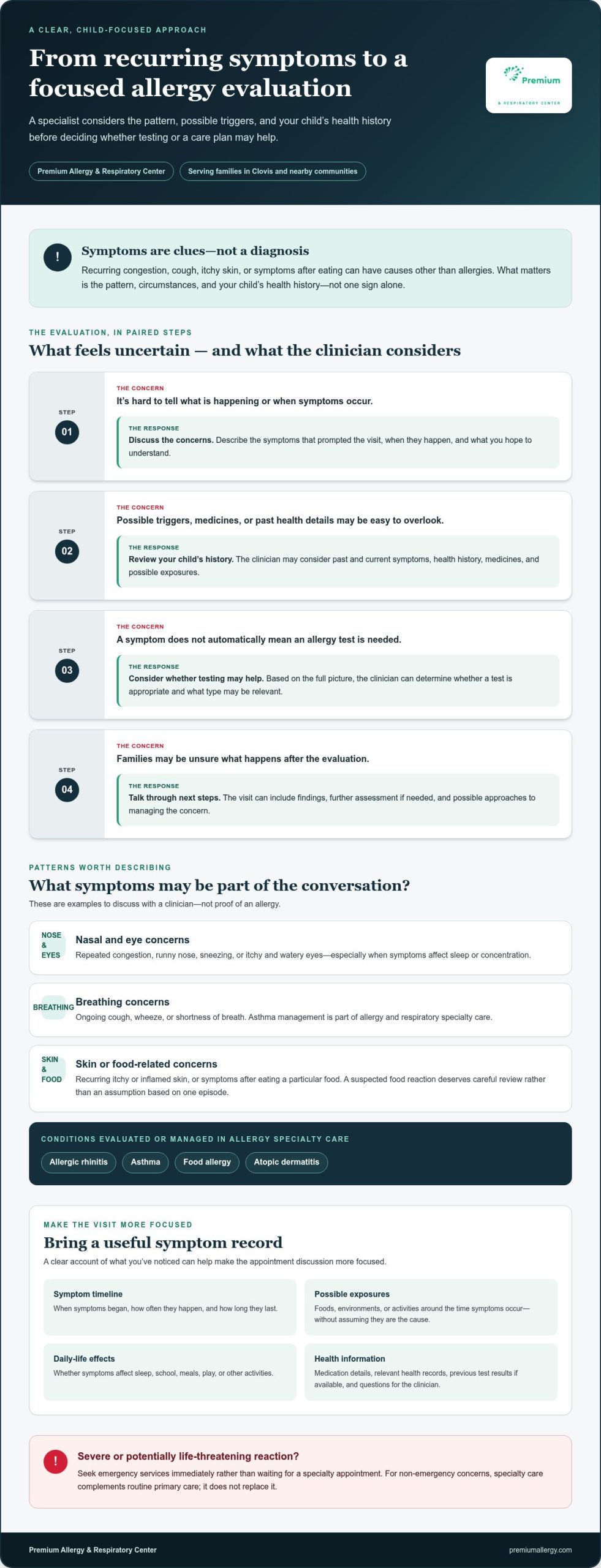
A little preparation can help you use appointment time well, especially when symptoms come and go or seem connected to different settings. You don’t need to arrive with a diagnosis or a perfect record. Bring what you’ve noticed, what you’re unsure about, and the questions you’d like answered. This information supports the discussion but doesn’t replace a clinician’s evaluation.
Gather details that help explain the pattern and its effect on your child. A short note on your phone is enough. Bring relevant records and information you already have, rather than trying to reconstruct every detail from memory.
Keep notes factual and simple. If you’re unsure whether an exposure matters, include it and let the clinician assess its relevance. Don’t change your child’s medication routine based on your notes alone; bring the medication details and discuss any questions with the clinician.
Clear questions can turn an evaluation into a useful plan. Choose the ones that fit your child’s situation:
For families seeking a child allergy specialist Clovis can access, Premium Allergy & Respiratory Center provides outpatient allergy and respiratory specialty care from Fresno and serves Clovis. Sharing a symptom timeline and your questions can help shape a focused conversation about your child’s concerns. Explore specialty allergy care as a next step toward an evaluation.
Choosing a next step can feel easier with a simple plan: identify the concerns affecting your child, understand how a specialty evaluation works, compare the care fit, and bring your questions. You don’t need to arrive certain that symptoms are allergy-related. A clear account of what you’ve noticed gives the clinician useful context to consider possible explanations and discuss appropriate next steps.
Premium Allergy & Respiratory Center is a Fresno-based allergy and respiratory specialty practice serving Clovis and nearby communities. Its outpatient care includes evaluation and management of allergic and respiratory conditions, with an individualized approach to care. For families looking for a child allergy specialist Clovis can access, the practice offers a local specialty-care option beyond general directory listings.
The symptom that first catches your attention can help guide a conversation, but it doesn’t establish a diagnosis by itself. A specialist can consider your child’s history and symptom pattern when assessing whether a particular area of allergy care may be relevant.
These areas can overlap in a family’s concerns, but that doesn’t mean every child needs the same tests or plan. A focused evaluation helps connect reported symptoms with the appropriate specialty discussion, rather than treating a single sign as a complete answer.
You’ve already done valuable work by noticing patterns, considering how symptoms affect daily life, and preparing questions. A specialist evaluation can help organize those observations and discuss possible explanations, whether testing may be useful, and what next steps could fit your child’s needs. Bring your notes and raise any concern that feels important, even if you’re unsure how it connects.
Premium Allergy & Respiratory Center serves families in Clovis from its Fresno-based practice. If you’re ready to explore specialty care, Connect with Premium Allergy & Respiratory Center and take the next step toward a more informed conversation about your child’s allergy or respiratory concerns.
You don’t have to resolve every uncertainty before seeking guidance. A specialist visit can be a place to share what you’ve observed, ask what the symptoms may suggest, and understand possible next steps without assuming a diagnosis in advance. If you’re considering a child allergy specialist Clovis families can access, focus on finding care that gives your concerns a clear, attentive evaluation.
Premium Allergy & Respiratory Center is a Fresno-based specialty practice serving Clovis and nearby communities, including Selma and North Clovis. Its diagnostic and management care includes allergic rhinitis, asthma, food allergy, and atopic dermatitis. Bring your questions and the details that feel relevant; they can help shape a useful conversation about your child’s needs.
Explore specialty allergy and respiratory care with Premium Allergy & Respiratory Center and take the next step toward an informed conversation about your child’s needs.
A specialist evaluation may be worth considering if symptoms keep returning, are hard to make sense of, or interfere with your child’s normal routines. For example, recurring symptoms after particular meals or repeated breathing concerns may prompt questions that benefit from focused allergy and respiratory care. A child allergy specialist Clovis families can access can assess the pattern and history; symptoms alone don’t confirm an allergy.
The first appointment generally focuses on understanding the concern before deciding what assessment may be useful. You can explain what you’ve observed, share relevant health background, and discuss how symptoms affect your child. Bring a short list of your main concerns so they’re addressed during the conversation. The clinician can then discuss possible next steps based on the information gathered.
Yes, children can have allergy testing when a clinician determines it may help assess a specific concern. The appropriate test depends on the child’s symptoms and history, so testing isn’t automatically needed for every child or suspected trigger. Premium Allergy & Respiratory Center offers blood allergy testing as part of its diagnostic services. A clinician can explain how testing may fit into an individual evaluation.
Bring a current medication list, relevant medical records, and any previous allergy test results or referral information you have. A brief note about when symptoms tend to occur can help, particularly if the pattern varies between school days and weekends or between indoor and outdoor activities. You might also bring written questions from other caregivers so the discussion reflects the family’s shared concerns.
Yes. Allergy and respiratory specialty care can address allergic conditions and asthma. Premium Allergy & Respiratory Center provides asthma management as well as care for allergic rhinitis, food allergy, and atopic dermatitis. If your child has both nasal and breathing concerns, describe each separately, including when they occur and whether they seem connected. The clinician can consider the full picture without assuming one condition explains every symptom.
Yes. Premium Allergy & Respiratory Center is based in Fresno and serves patients in Clovis and nearby communities, including Selma and North Clovis. The practice focuses on outpatient allergy and respiratory specialty care. Families can explore its diagnostic and management services for allergic and respiratory conditions as a local specialty-care option.
Test results are considered alongside a child’s symptoms and medical history, rather than used by themselves to define the problem. For instance, the clinician may compare a result with the timing and circumstances of the symptoms that led to testing. That context can inform a discussion about whether a suspected trigger is relevant and what management options may be appropriate for the child.
If you’re searching for an “asthma doctor for kids Selma CA,” recurring cough, wheezing, or shortness of breath can leave you wondering whether your... Continue reading
READ MORE
Could recurring congestion, itchy skin, coughing, or reactions to food point to an allergy, or could something else be causing your child’s symptoms?... Continue reading
READ MORE
What if your spring allergies aren’t just bad luck, but a sign that your current plan is missing important triggers? In Fresno, oak, mulberry, and... Continue reading
READ MORE
What if the most useful clue isn’t a suspected trigger, but the pattern of your child’s symptoms? A stuffy nose that returns each spring, a recurring... Continue reading
READ MORE