
Could another allergy evaluation clarify why your symptoms persist, rather than simply repeat the same tests? If you’re searching “second opinion for... Continue reading
READ MORE

What if recurring wheezing, coughing, or chest tightness could help point the way to a clearer asthma plan? If you’re searching for an asthma specialist Selma residents can access, it’s understandable to want answers about what may be triggering symptoms and whether specialist care could help.
When breathing symptoms return or feel difficult to manage, you don’t have to keep guessing. An asthma specialist evaluation can offer a focused review of your symptoms and support a personalized approach to ongoing care. Premium Allergy & Respiratory Center provides outpatient asthma management for people in Selma, Fresno, Clovis, and North Clovis.
In this article, you’ll learn when specialist input may be useful, what information to bring, and what an evaluation may cover. You’ll also get a clearer picture of how personalized asthma care can help turn recurring symptoms into a more informed management plan. Your evaluation and next steps should reflect your individual needs.
Recurring breathing symptoms can leave you wondering what’s happening and whether you need more focused help. If you’re looking for an asthma specialist Selma residents can access, pay attention to how often symptoms occur, what seems to surround them, and whether they interfere with your routine. A pattern is worth discussing, but it doesn’t confirm asthma on its own.
Consider discussing specialist care if coughing, wheezing, chest tightness, or shortness of breath persists, changes over time, or disrupts sleep, exercise, work, school, or everyday activities. Symptoms that flare in particular settings or at certain times can also be useful details to share. You don’t need to identify a cause before an appointment. A clear description of what you’ve noticed is a helpful starting point.
Asthma is one possible explanation for breathing symptoms, but other factors can cause similar concerns. A general Asthma Overview can explain common symptoms and provide broader context. A clinician can consider your individual history and concerns rather than relying on a checklist or a single symptom.
Note what you experience and how it affects your routine. A brief record can make it easier to describe the pattern at an appointment, but it doesn’t replace clinical evaluation.
Include timing and frequency, such as whether symptoms appear during activity, at night, or in a particular environment. You don’t need to decide whether a detail is a trigger. Share what you’ve noticed and what remains uncertain.
Specialist guidance may be helpful when symptoms keep returning, questions remain after earlier discussions, or it’s hard to make sense of when breathing concerns occur. A focused evaluation can explore your experience and inform an individualized asthma care approach. It can also complement care you already receive, helping keep your respiratory concerns in focus while your broader health needs remain part of the picture.
Symptoms can raise a question about asthma, but only a clinical evaluation can help determine what may be causing them. A symptom log can organize your observations, but it can’t establish a diagnosis or indicate how serious a condition is. Share your concerns openly, including what you’ve tried and what you’d like to understand. A clear account of your experience can help you take a more informed next step toward ongoing care.
An asthma specialist evaluation brings your symptoms, health history, and questions into a focused clinical review. For people searching for an asthma specialist Selma residents can access, knowing the general steps can make the visit feel more manageable. You’ll have an opportunity to describe what’s happening, ask questions, and discuss what may help clarify your next steps.
The appointment may follow a sequence like this, shaped by your concerns and the clinician’s judgment:
Before the visit, jot down when your symptoms began, how often they occur, and whether anything seems to affect them. Note whether breathing concerns interrupt sleep, limit activity, or change your usual routine. Bring a current medication list and relevant information from prior evaluations, if you have it. These details offer helpful context, even if you’re unsure what triggers the symptoms.
You don’t need to arrive with a complete explanation. Your notes are a starting point for a conversation, not a substitute for clinical assessment. The clinician may ask follow-up questions to understand how your experiences fit together and what remains uncertain.
A clinician may consider breathing tests as part of an evaluation, but testing isn’t automatic or identical for everyone. Whether testing is appropriate and how findings are interpreted depend on your symptoms, history, and overall clinical picture. Your clinician can explain the purpose of any proposed evaluation and how it may inform next steps.
Bring your questions, too. You might ask what the evaluation is intended to clarify, how your current care fits into the discussion, or what to do if symptoms change. The NHLBI Asthma Facts and Treatment resource provides background on asthma and action plans; your own plan should reflect a discussion with your clinician. A practical asthma management plan guide can also help you identify topics to discuss about ongoing care.
Premium Allergy & Respiratory Center provides outpatient asthma management for Selma and nearby communities, including Fresno, Clovis, and North Clovis. Learn about asthma specialty care and bring your questions into the conversation.
General care and asthma specialty care can serve complementary purposes. A clinician who knows your broader health history may help coordinate care, while a focused asthma evaluation gives more attention to respiratory symptoms and asthma management. You don’t have to choose one role for every concern. The right approach depends on your symptoms, health history, and clinical judgment.
Specialist input isn’t only for people with severe symptoms. Recurring questions, uncertainty about a care approach, or breathing concerns that affect everyday routines may also be reasons to discuss a focused evaluation. Seeking perspective doesn’t mean your asthma is severe, and it doesn’t require stepping away from clinicians already involved in your care.
| Care role | How it may help |
|---|---|
| General care coordination | Considers overall health, reviews concerns in a broader context, and helps coordinate ongoing care. |
| Focused asthma specialty evaluation | Centers the discussion on breathing symptoms, asthma-related questions, and an individualized management approach. |
This comparison describes different areas of focus, not competing choices. A general clinician may remain an important part of your care, while an asthma specialist can bring added attention to respiratory concerns. For people seeking an asthma specialist Selma residents can access, specialty care can be a supportive next step when a more focused review would be useful.
A focused discussion can help you explore what recurring symptoms might mean, whether particular circumstances seem connected to them, and what an evaluation is intended to clarify. It can also help you understand how your current asthma care fits your needs and what questions to raise about ongoing management. The review may offer useful perspective, but it can’t promise one identifiable cause or answer every concern.
To make the conversation productive, consider naming the questions that matter most to you. For example, you may want to understand how to describe a changing symptom pattern or what to discuss if breathing concerns are affecting your routines. The clinician can consider those questions alongside your individual history rather than drawing conclusions from one detail alone.
Asthma and allergic conditions can occur together, though the combination and its effects vary from person to person. If you also have nasal allergy symptoms, mention them alongside breathing concerns. That context may inform a broader discussion of your health, without assuming allergies explain every respiratory symptom. For more information on nasal allergy care, explore this allergic rhinitis specialist guide.
Ultimately, the care pathway should reflect your needs, not a label or assumption about severity. Sharing your concerns with your current care team can help you discuss whether focused asthma specialty input may be appropriate while keeping care coordinated.
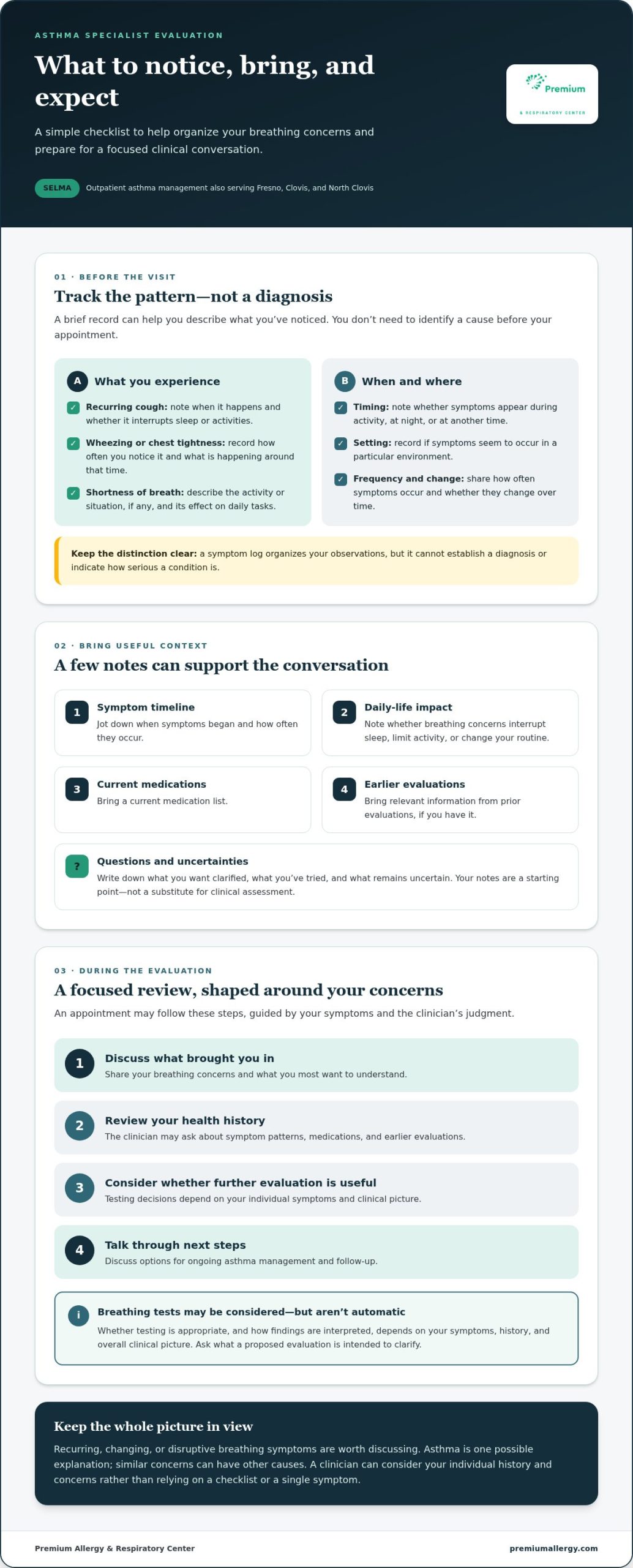
A little preparation can help you use your appointment time well. You don’t need to arrive with a diagnosis or a complete explanation of every symptom. A few notes about what you’ve experienced, what has changed, and what you want to understand can give the conversation a clear starting point.
Capture the details you can remember, even if your notes are brief. Record when symptoms occurred, how often they return, how long they last, and what was happening at the time. If symptoms seem connected to an activity, setting, or exposure, record it as an observation rather than a confirmed trigger.
These notes don’t need to be polished. For instance, “cough after evening walks” is a useful observation, even if you don’t know whether the walk, time of day, or something else is related. A record can help you recall details, but the clinician will consider them in context rather than treating them as proof of a cause.
Start by sharing what concerns you most and what you hope to learn. Mention changes since earlier care, such as a new symptom pattern or a shift in daily routines. If you’re unsure where to begin, share the one question you most want answered. The conversation can build from there.
It may also help to say what feels unclear. You might ask what an evaluation is meant to clarify, how your current care fits into the discussion, or what changes should prompt another conversation with your clinician. Open questions can help focus the visit on your priorities without assuming a particular test, diagnosis, or outcome.
Preparation is for a scheduled appointment, not a substitute for urgent care. If you’re experiencing severe breathing distress, seek emergency help rather than waiting for a routine visit.
Premium Allergy & Respiratory Center provides personalized outpatient asthma management for people in Selma and nearby communities, including Fresno, Clovis, and North Clovis. If you’re ready to explore a focused asthma care conversation, connect with Premium Allergy & Respiratory Center.
If recurring breathing concerns have left you with unanswered questions, a focused asthma care conversation can be a constructive next step. Premium Allergy & Respiratory Center provides outpatient specialty care for asthma and serves Selma, Fresno, Clovis, and North Clovis. Asthma management is centered on individual needs, since symptoms and care priorities differ from person to person.
Care discussions can take your symptoms, health history, questions, and clinical evaluation into account. Sharing what you’ve noticed and what you want to understand helps shape a conversation around your experience rather than a one-size-fits-all approach. You can discuss ongoing respiratory concerns, what an evaluation may help clarify, and possible next steps for asthma management.
Personalized care doesn’t mean a particular diagnosis or outcome is guaranteed. It means your concerns can be considered in context, with the aim of developing an approach informed by your circumstances and clinical judgment. If you already receive care from another clinician, specialty asthma care can be part of a coordinated approach rather than a reason to set that relationship aside.
For someone searching for an asthma specialist Selma residents can access, Premium Allergy & Respiratory Center provides outpatient specialty care in the area. The practice focuses on asthma and other allergic or respiratory conditions, not emergency services or general primary care.
Start with the questions you most want to address. You might want to discuss recurring symptoms, understand what an evaluation may involve, or explore options for ongoing asthma management. A clear sense of your concerns can help begin a useful conversation, even if you don’t yet know what may be contributing to them.
Premium Allergy & Respiratory Center welcomes people from Selma and nearby communities who are seeking asthma specialty care. Contact the practice to discuss outpatient asthma management and take a confident next step toward a more individualized care conversation. You deserve to feel heard as you work to understand your respiratory health.
You don’t need to have every answer before moving forward. A first conversation can be a starting point, and your understanding of your breathing concerns can develop as you share questions and discuss your care. The goal is to make space for a thoughtful, individualized approach.
If you’re considering an asthma specialist Selma residents can access, choose a next step that feels manageable. Begin by identifying the main concern you want to discuss, then explore specialty care. Focused support can help you approach ongoing asthma management with greater clarity, while keeping decisions grounded in your individual needs.
Explore asthma specialty care with Premium Allergy & Respiratory Center and take a confident step toward a more informed care conversation. You deserve support that takes your concerns seriously and helps you move forward with confidence.
No, asthma specialty care isn’t automatically necessary for everyone. It may be worth discussing if symptoms keep returning, your current management raises questions, or breathing concerns interfere with activities you value. For example, if you’re unsure how to describe changes since your last visit, bring that concern to a clinician. They can help you consider whether a specialist evaluation fits your needs. This information doesn’t replace individualized medical advice or urgent care.
Yes, you can discuss breathing symptoms with a clinician even if asthma hasn’t been confirmed. The conversation can consider your history and what you’ve experienced, then explore appropriate next steps. For example, explain whether symptoms occur in particular situations, but avoid treating that pattern as proof of asthma. Evaluation and testing decisions vary by person. If breathing becomes severely difficult or rapidly worsens, seek emergency help instead of waiting for a routine appointment.
Bring a current medication list, relevant records you already have, and a few notes about your breathing concerns. Include when symptoms happen and how they affect sleep or usual activities. If you use several medications, writing down their names can be easier than trying to recall them during the visit. Add questions you want answered, too. You don’t need to identify a cause before the appointment; your observations simply help start the discussion.
A clinician may consider breathing tests, depending on your symptoms and medical history. There isn’t one assessment that applies to every person, and a test result is considered alongside other information about your health. If testing comes up, ask what the proposed evaluation is intended to clarify and how its findings may inform next steps. This can help you understand the discussion without assuming that a test alone will settle every question.
Asthma and allergic conditions can occur together, but that doesn’t mean an allergy is necessarily causing your breathing symptoms. If you also experience nasal or other allergy concerns, mention them during the evaluation so the clinician has a fuller picture. For instance, describe whether the concerns occur at the same time or separately. Your personal history matters, and a clinician can discuss whether further evaluation or coordinated management may be appropriate.
Yes. Premium Allergy & Respiratory Center provides outpatient specialty care, including asthma management, and serves Selma as well as Fresno, Clovis, and North Clovis. The practice focuses on allergy and respiratory specialty care, not emergency services or general primary care.
Seek emergency help right away rather than waiting for a routine appointment or an online reply. Call 911 or go to emergency care, especially if breathing is rapidly worsening or you can’t speak normally. If your clinician has given you emergency instructions, follow them while getting help. Once the immediate danger has passed, tell your healthcare team about the episode so you can discuss what it may mean for your ongoing care.
Could another allergy evaluation clarify why your symptoms persist, rather than simply repeat the same tests? If you’re searching “second opinion for... Continue reading
READ MORE
What if recurring wheezing, coughing, or chest tightness could help point the way to a clearer asthma plan? If you’re searching for an asthma... Continue reading
READ MORE
For families exploring EoE diet management Selma, the safest first step may be replacing guesswork with a monitored plan, not cutting out more foods.... Continue reading
READ MORE
Are allergy symptoms disrupting your sleep, daily routine, or breathing while you wonder whether you can be seen today? A same day allergy... Continue reading
READ MORE