What if the pollen, dust mites, or mold you suspect aren’t the whole story behind your symptoms? Environmental allergy testing can help identify... Continue reading
READ MORE

Could the product you added to your routine be irritating your skin, or is something else behind the redness and itching? Contact dermatitis on face can cause burning, dryness, swelling, or an itchy rash, and the trigger isn’t always something you apply directly. Shampoo or conditioner that rinses over your skin may also be relevant. Pinpointing the cause can take patience, especially when facial skin is uncomfortable and the rash is visible.
Advice that helps one kind of rash may not suit another. This guide explains allergic and irritant contact dermatitis in plain language, how they can differ from atopic dermatitis and other facial rashes, and why “natural” or “hypoallergenic” products aren’t guaranteed to be gentle. You’ll learn what details to record about products and exposures, which cautious steps may help while you assess the rash, and when persistent, recurring, severe, or unexplained symptoms warrant professional evaluation. A clear timeline and product list can help you take a more informed next step.
Contact dermatitis is skin inflammation that develops after the skin touches an irritant or an allergen. On the face, it may cause redness, itching, burning or stinging, dryness, scaling, and sometimes swelling. A rash’s appearance alone can’t reliably identify its cause or distinguish contact dermatitis from every other facial skin condition. Contact dermatitis includes allergic and irritant forms, which arise through different processes.
The rash’s location and timing may help you and a clinician review possible exposures, but they can’t establish a diagnosis. Contact dermatitis on face can resemble other conditions, including atopic dermatitis. Avoid assuming that every itchy or red patch has the same cause or needs the same treatment.
A rash can affect the eyelids, cheeks, lips, or forehead, or appear where your hands or products touch the skin. A product used near the hairline, for example, may be worth noting if the rash appears there. Repeated hand contact may also be relevant to areas you touch often. These patterns can suggest what to review, but they don’t confirm the trigger. Eyelid skin is delicate, so take extra care with products and treatments used around the eyes.
Timing can offer another clue. Irritant reactions may follow one sufficiently strong exposure or build after repeated contact with something that bothers the skin. Allergic reactions can be delayed, so a rash may not appear right away. Because timing varies, record when symptoms began and what touched the area beforehand, but don’t treat the timeline as proof.
As you observe the rash, note where it started, how it changed, and which products or exposures may be relevant. Include items that contact the face indirectly, such as hair products that rinse over the skin or materials you handle before touching your face. A suspected product is useful information, not a confirmed cause; another exposure or skin condition may explain the symptoms.
Seek prompt medical attention if symptoms are rapidly worsening or severe. Breathing difficulty or other signs of a serious allergic reaction need emergency care. Significant eye swelling, eye pain, or changes in vision also warrant prompt medical assessment. If you’re unsure how urgent your symptoms are, contact a qualified medical professional for guidance.
Allergic and irritant reactions can look similar but start in different ways. Allergic contact dermatitis happens when the immune system reacts to a substance after becoming sensitized to it. Irritant contact dermatitis is direct skin irritation or damage, which can follow repeated exposure or contact with something sufficiently harsh. Either form can affect facial skin, and symptoms alone can’t reliably tell them apart.
| Type | Mechanism | Typical exposure pattern | Possible clues, not diagnostic |
|---|---|---|---|
| Allergic | Immune reaction to a specific substance | Contact with a substance the person has become sensitized to | Rash may be delayed; itching is common |
| Irritant | Direct irritation or injury to the skin | One strong exposure or repeated contact | Burning or stinging may occur; the affected area may match contact |
These patterns are clues, not a way to self-diagnose. Cosmetics, fragrances, cleansers, topical products, jewelry, and hair products may all be relevant exposures. Possible allergic triggers include fragrance ingredients, preservatives, metals, and ingredients in skin or hair products. The Common Causes of Contact Dermatitis include substances that can trigger allergy as well as exposures that can irritate skin.
A product you’ve used without trouble before may still be relevant if you develop sensitivity to an ingredient over time. That doesn’t mean the product is definitely responsible, so consider its ingredients alongside other exposures. “Natural” and fragrance-free labels also don’t guarantee that a product won’t irritate your skin or trigger an allergy. Keep track of what you use, when you use it, and where it touches your face.
Atopic dermatitis is a distinct condition, though it can share symptoms with contact dermatitis. Rosacea, seborrheic dermatitis, and perioral dermatitis can also cause facial changes that may be mistaken for contact dermatitis. Appearance and location alone may not separate them; a clinician may consider your history, exposures, and examination findings. Learn more about atopic dermatitis treatment options.
If atopic dermatitis may be part of the picture, you can also explore specialty care for atopic dermatitis. This care is distinct from determining whether a particular exposure caused contact dermatitis.
An itchy facial rash doesn’t automatically mean you have an allergy. Irritation from contact with a substance, atopic dermatitis, and other skin conditions can produce overlapping symptoms. Even if a rash appears after you use a particular product, that timing is a clue to investigate, not proof that the product caused it. Another exposure or an unrelated condition may be involved, so stopping one item may not settle the question.
Rash appearance alone can’t confirm a contact allergy because different skin conditions can look alike, and the same trigger can affect people differently. Mayo Clinic’s overview of contact dermatitis symptoms and causes explains the difference between allergic and irritant reactions. Keeping a record of products and exposures adds useful context, but it can’t establish a diagnosis on its own.
Marketing language isn’t a guarantee that a product will suit your skin. Individual ingredients can irritate or trigger an allergic reaction regardless of whether a product is described as natural or hypoallergenic. Check ingredient lists and note products used near the time symptoms began, including items that may touch your face indirectly. Don’t conclude that a specific ingredient is responsible without an appropriate evaluation.
Contact dermatitis is associated with skin exposure to an irritant or allergen. Atopic dermatitis is a distinct skin condition, and its symptoms can overlap with contact dermatitis. The two may also occur together, so a rash’s location or appearance may not tell you which is involved. Other facial conditions can resemble either one, too. For related information, see this eczema treatment specialist guide.
These distinctions matter because a plan that fits one condition may not address another. If simplifying your routine or avoiding a suspected product doesn’t resolve the rash, consider whether other exposures or a different skin condition could be contributing. Persistent or recurring symptoms are a reason to seek professional guidance rather than repeatedly eliminating products based on guesswork. A clinician can review your history and examine the skin to help determine an appropriate next step.
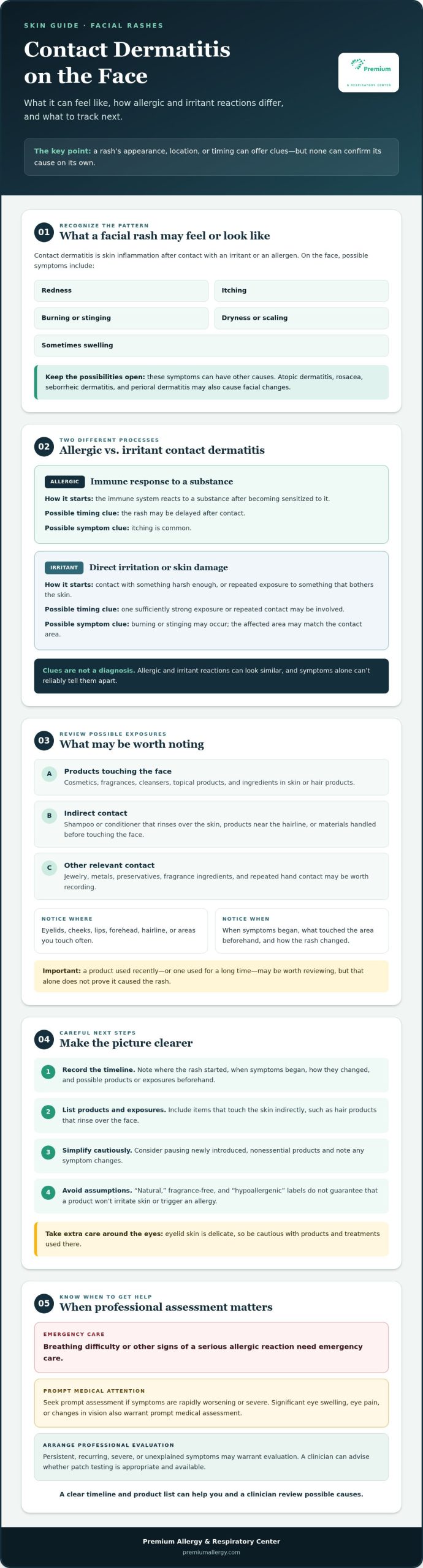
If you suspect contact dermatitis on face, keep your next steps simple and cautious. Pause newly introduced, nonessential products that touch the affected area, then simplify your routine rather than replacing everything at once. Gentle cleansing and a bland moisturizer may be reasonable if your skin tolerates them. Stop using anything that stings or worsens irritation.
Skip harsh scrubs, exfoliants, and multiple new remedies while your skin is reactive. Facial skin, especially around the eyes, needs extra care. Don’t apply medication near your eyes or use a treatment there without professional guidance, since the appropriate approach depends on the cause and location of the rash.
A simple exposure diary can turn scattered observations into useful information for a clinician. Record when symptoms began, which areas are affected, and products used on or near your face. Include possible work or household exposures, and save ingredient lists or packaging details. Note what you stopped or changed and whether symptoms improved, worsened, or returned.
Arrange medical advice if symptoms persist, recur, worsen, or remain unclear despite simplifying your routine. Seek prompt assessment for significant eye involvement, severe swelling, spreading symptoms, or concerning pain. Don’t wait to see whether another product change helps if symptoms are escalating.
Breathing difficulty or signs of a severe reaction affecting more than the skin require emergency services. For other ongoing facial concerns, a clinician can review your symptom history and exposures, assess possible causes, and discuss appropriate next steps. Bring your diary and product details if you can; they may help make the conversation more focused.
If you’re also seeking support for atopic dermatitis, explore atopic dermatitis care options and ask whether the practice’s services fit your needs. Contact dermatitis and atopic dermatitis are distinct conditions, so persistent facial symptoms may need assessment rather than continued home experimentation.
Consider professional evaluation if a facial rash keeps returning, persists despite avoiding suspected triggers, worsens, or has no clear explanation. A clinician can review when symptoms began, what has contacted your skin, and what treatments you’ve tried. They may examine the affected areas and consider other conditions that can resemble contact dermatitis. For instance, if an evaluation indicates that persistent flushing or irritation is due to rosacea rather than an allergen, the Rosacea Treatment Clinic provides specialized skincare solutions formulated for sensitive, rosacea-prone skin. This assessment can help guide next steps without relying on appearance alone.
If allergic contact dermatitis is being considered, patch testing may be one clinician-directed way to investigate possible allergens. It isn’t appropriate for every rash, and availability varies, so ask the clinician what diagnostic options are offered locally. Blood allergy testing does not confirm contact dermatitis.
A little preparation can make the appointment more focused. Bring a timeline of symptom changes, a list of products used on or near your face, and ingredient labels or packaging when available. Photographs can show how the rash has changed between visits. Also note any previous skin conditions, treatments you’ve used, and reactions or sensitivities you’ve noticed.
Ask which possible causes fit your history and examination, what next steps are appropriate, and whether any testing is being considered. If you’re unsure whether a particular service is available locally, confirm before scheduling.
Persistent facial symptoms may warrant help from a clinician familiar with allergic and inflammatory skin conditions. Contact dermatitis and atopic dermatitis are different conditions that can sometimes look alike, so clarify whether a provider evaluates your concern and what services they offer. For broader information about reactions, see this guide to allergic reaction symptoms and causes.
Premium Allergy & Respiratory Center provides outpatient specialty care for atopic dermatitis and allergic conditions in Fresno, Clovis, Selma, and North Clovis. The practice’s confirmed services include atopic dermatitis care; contact the clinic to ask whether its scope and available services fit a concern about suspected contact dermatitis. Explore specialty allergy and atopic dermatitis care.
Facial redness, itching, or burning can have more than one explanation. Contact dermatitis on face may result from irritation or an allergic response, but its appearance alone can’t confirm the cause or rule out conditions such as atopic dermatitis. A clear record of products, exposures, and symptom changes can give a clinician useful context.
If the rash persists, returns, worsens, or remains unexplained, consider professional guidance rather than continuing to test new products on delicate facial skin. Premium Allergy & Respiratory Center provides personalized outpatient care for atopic dermatitis and complex allergic conditions in Fresno, Clovis, Selma, and North Clovis. Contact the practice to learn whether its services fit your needs.
Explore specialty allergy and atopic dermatitis care and take your next step with more clarity and confidence.
Contact dermatitis on the face can cause red, itchy, dry, scaly, or burning skin, and sometimes swelling. It may affect the eyelids, cheeks, lips, or other areas exposed to a product or irritant. The rash can look different from person to person and may resemble atopic dermatitis or another facial skin condition. Appearance alone can’t confirm the cause, so consider timing and possible exposures as clues, not a diagnosis.
You usually can’t tell for certain from symptoms alone. Allergic contact dermatitis involves an immune response to a substance, while irritant contact dermatitis results from direct skin irritation or damage. Irritation may follow repeated contact or a strong exposure; an allergic reaction can be delayed. Itching, burning, and the rash’s timing may offer clues, but they aren’t diagnostic. A clinician can review your exposure history and skin findings to consider the possibilities.
Yes. A face cream may contain an ingredient that irritates your skin or triggers an allergic reaction. A product you’ve used before may also become relevant if sensitivity develops over time. Still, a rash appearing after you start a cream doesn’t prove that it caused the problem. Consider pausing newly introduced, nonessential products, keeping the packaging or ingredient list, and noting when you used the cream and when symptoms began.
There isn’t one timeline that applies to everyone. Symptoms may continue after you stop using a suspected product, and recovery can depend on the cause, the exposure, and whether contact continues. If the rash isn’t improving, keeps returning, or gets worse, seek medical advice rather than waiting for a particular number of days or trying several new treatments. A clinician can assess whether another condition may be contributing and discuss appropriate next steps.
Don’t use hydrocortisone on or near your eyelids unless a clinician specifically advises you to. The skin around the eyes is delicate, and treatment choices depend on the cause and location of the rash. Avoid applying other medicated creams there without professional guidance, too. If you have significant eyelid swelling, eye pain, or vision changes, seek prompt medical assessment. For breathing difficulty or signs of a severe allergic reaction, contact emergency services.
Seek medical advice if the rash is persistent, recurring, worsening, severe, or difficult to explain. Significant eye involvement, severe swelling, spreading symptoms, or concerning pain warrant prompt assessment. A clinician may review your symptom timeline, exposures, examination findings, and other possible causes. Premium Allergy & Respiratory Center provides atopic dermatitis care in Fresno, Clovis, Selma, and North Clovis; contact the practice to confirm whether its services fit a concern about suspected contact dermatitis.
No. An allergy blood test doesn’t confirm contact dermatitis, which involves a skin response to an irritant or, in allergic contact dermatitis, a substance the immune system has become sensitized to. A clinician may consider your history and examination and, when appropriate, discuss patch testing as a way to investigate possible contact allergens. Availability varies. Ask the clinician which evaluation methods are suitable and offered locally; don’t assume a blood test identifies the cause of a facial rash.
What if the pollen, dust mites, or mold you suspect aren’t the whole story behind your symptoms? Environmental allergy testing can help identify... Continue reading
READ MORE
A positive allergy blood test doesn’t automatically mean a substance is causing your symptoms. The test measures specific immunoglobulin E (IgE)... Continue reading
READ MORE
Could a past sting reaction put you at risk the next time you’re outdoors? It’s understandable to feel uneasy about another sting, especially if... Continue reading
READ MORE
A penicillin allergy label deserves a careful evaluation, not a guess. If you’re searching for penicillin allergy testing near me, you may be unsure... Continue reading
READ MORE