
Could a sting that starts with a sore, swollen spot become an emergency? The difference often comes down to whether symptoms stay near the sting or... Continue reading
READ MORE

Could symptoms that flare around your pet have more than one explanation? Sneezing, itchy eyes, or congestion after time with an animal can raise a real concern, but the pattern alone can’t confirm the cause. A pet dander allergy specialist Selma residents can turn to will consider when symptoms appear, how they relate to exposure, and whether other triggers may be involved. A suspected allergy doesn’t automatically mean you have to give up a beloved pet.
It’s understandable to want a clear answer before making changes at home. Premium Allergy & Respiratory Center provides outpatient allergy and respiratory specialty care for Selma and the wider Fresno area. An evaluation connects your symptoms and exposure history with relevant clinical findings. Blood allergy testing may contribute, but results are considered alongside your clinical history, not as the whole answer. In this guide, you’ll learn what a specialist may ask, what information to bring, and how personalized care can address suspected pet related symptoms and relevant triggers.
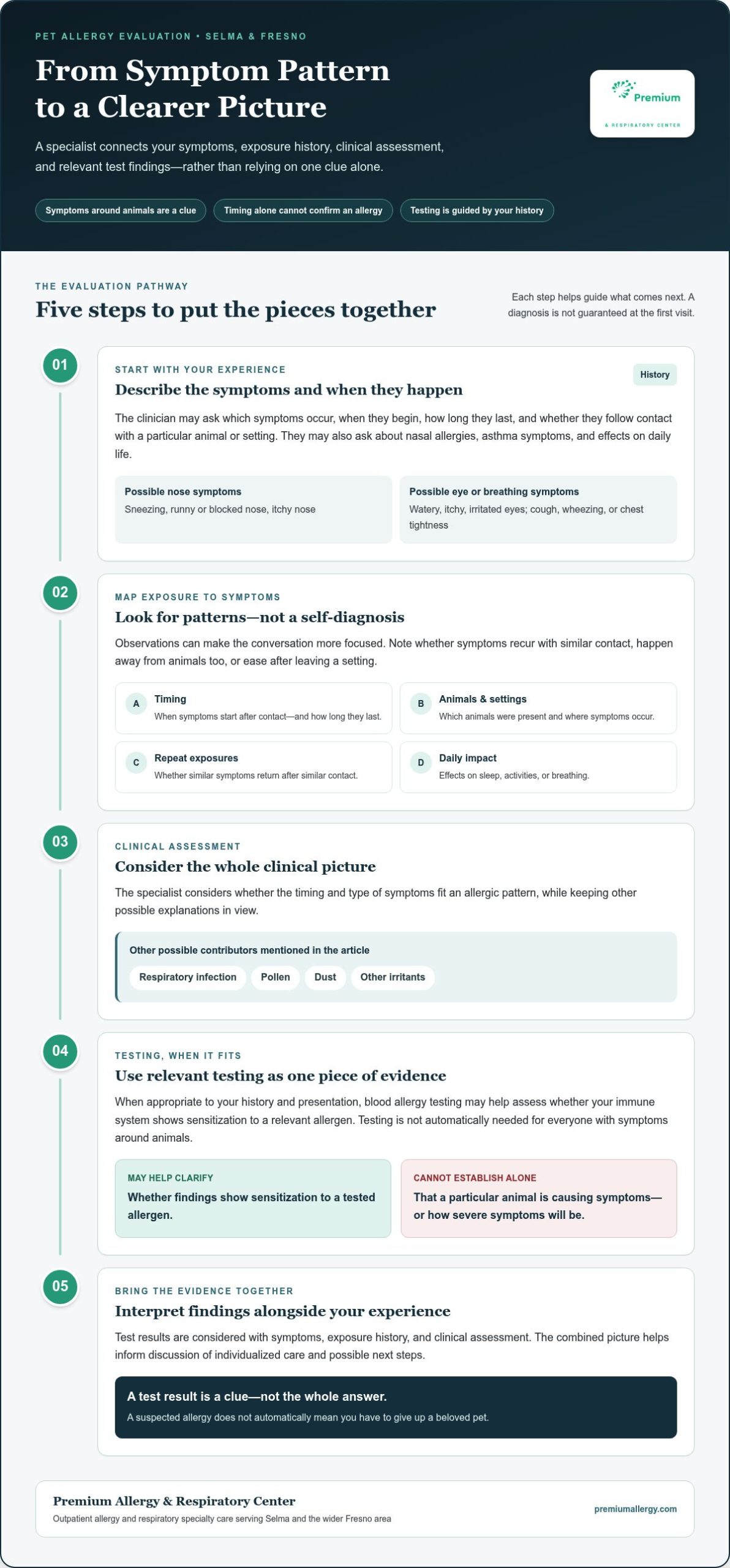
Sneezing after cuddling a cat, congestion after visiting a home with a dog, or itchy eyes around animals can make you wonder whether a pet is the trigger. But symptoms that return around animals don’t prove an allergy. A stuffy nose or cough can have other causes, including a respiratory infection, pollen, dust, or other irritants. Noticing a pattern is a useful first step, not a diagnosis.
Animal allergies can involve proteins found in materials such as dander, saliva, or urine. For a comprehensive overview of animal allergies, you can review how exposure may relate to symptoms. A specialist considers your experience and clinical picture rather than assuming every reaction around a pet has the same cause. Premium Allergy & Respiratory Center provides outpatient allergy and respiratory specialty care in Selma and the wider Fresno area, including evaluation of allergic concerns and allergic rhinitis care.
Possible nose symptoms include sneezing, a runny or blocked nose, and an itchy nose. Eyes may feel watery, itchy, or irritated. Some people also notice coughing, wheezing, chest tightness, or other breathing symptoms, particularly if they have asthma. These signs can overlap with other conditions, so no single symptom confirms an animal allergy. A clinician can assess what may be contributing and whether further evaluation is appropriate.
Bring observations, not a self diagnosis. A few notes can make the conversation more focused:
Patterns may be subtle, and other exposures can occur at the same time. Sharing what you’ve noticed helps a pet dander allergy specialist serving Selma weigh your history alongside a clinical assessment instead of jumping to conclusions. You don’t need to decide what the cause is, or what to do about your pet, before seeking specialist guidance.
A thoughtful evaluation is a process, not a test result in isolation. A pet dander allergy specialist serving Selma considers your symptoms, exposure history, clinical assessment, and relevant test findings to build a clearer picture. Each step helps guide the next, so testing can be selected based on your individual history and presentation.
The conversation starts with what you’ve noticed: which symptoms occur, when they begin, how long they last, and whether they follow contact with a particular animal or setting. The clinician may also ask about your health history, including nasal allergies or asthma symptoms, and how these concerns affect daily life.
The specialist then considers whether the timing and type of symptoms fit an allergic pattern, while keeping other possible explanations in view. You can read more about Pet allergy symptoms and causes from Mayo Clinic, then bring any questions to your appointment. The assessment can clarify useful next steps, though a diagnosis isn’t guaranteed at the first visit.
When it fits the clinical picture, allergy testing may help assess whether your immune system shows sensitization to a relevant allergen. Premium Allergy & Respiratory Center provides blood allergy testing as part of its diagnostic services. Whether testing makes sense, and which test is appropriate, depends on your history and presentation. Testing isn’t automatically needed for everyone with symptoms around animals.
Test findings make the most sense when interpreted alongside your symptoms and exposure history. A result can offer a useful clue, but by itself it doesn’t establish that a particular animal is causing your symptoms. The clinician considers how the finding aligns with your experience and the overall assessment before discussing individualized care.
This approach can replace guesswork with a more informed plan. Premium Allergy & Respiratory Center provides outpatient allergy and respiratory specialty care for Selma and the wider Fresno area, including allergic rhinitis management and blood allergy testing. Learn more about allergy and respiratory specialty care as you consider your next step.
A test result can add useful information, but it doesn’t tell the whole story. Understanding what it means requires connecting it with your symptoms, exposure history, and clinical assessment. The National Institute of Environmental Health Sciences explains how Pet Allergens can be present in the environment, which is one reason the details of where and when symptoms occur matter.
| Information | What it may help clarify | What it can’t establish alone |
|---|---|---|
| Exposure history | Whether symptoms seem to follow contact with an animal or a particular setting. | That the animal is definitely the cause. |
| Test findings | Whether the results show sensitization to a tested allergen. | How severe symptoms will be or whether exposure causes symptoms in daily life. |
| Clinician’s interpretation | How the history, symptoms, assessment, and relevant test results fit together. | A one size fits all answer about what you must do next. |
No. A positive result is one part of an overall clinical assessment, not automatic proof that a specific animal is causing your symptoms. The clinician considers whether the finding aligns with the symptoms you experience and the exposures in your history. A positive result also doesn’t, by itself, predict how intense symptoms may be. An online test result alone can’t replace diagnosis and care decisions made with a qualified clinician.
A negative or unclear finding still needs to be considered in context. Your symptoms, the timing of exposures, and the questions addressed by the evaluation all matter. Rather than drawing conclusions from a result in isolation, discuss how it fits with your experience. A pet dander allergy specialist serving Selma can help interpret relevant findings and explain what they may mean for your situation.
That worry can feel especially heavy when a pet is part of your family. A test result doesn’t dictate one choice for everyone, and it can’t promise that your relationship with a particular pet will continue unchanged. Recommendations depend on your symptoms, assessment, and circumstances. A specialist can help you understand the evidence and consider informed next steps without making a major decision based on a result alone.
A little preparation can make your visit more focused and help you explain what’s been happening. You don’t need to arrive with a diagnosis. Bring your observations and questions so the specialist can consider your symptoms, exposures, and health history together.
Before meeting with a pet dander allergy specialist serving Selma, jot down a few practical details. A simple note on your phone is enough:
These notes can reveal details that are easy to forget during a conversation. For broader guidance on nasal and eye allergy care, explore the clinic’s allergic rhinitis specialist guide.
Tell the clinician if you experience coughing, wheezing, chest tightness, or shortness of breath, and note when these symptoms happen and how they affect you. Breathing symptoms can have different causes, so they don’t establish asthma on their own. Sharing them helps the clinician consider your respiratory history as part of the evaluation. The clinic also provides asthma management as part of its respiratory specialty care.
Patients from Selma can access outpatient allergy and respiratory specialty care through Premium Allergy & Respiratory Center, serving Selma and the wider Fresno area. With your observations in hand, you can take a more informed next step. Explore allergy and respiratory care to learn more about the clinic.
Recurring symptoms around animals can leave you weighing possibilities and wondering what to change. A clear next step is to share your exposure patterns and health history with an allergy specialist. The specialist can assess whether the symptoms fit an allergic pattern and whether testing may help. From there, your clinician can discuss care based on the full picture, rather than a single symptom or test result.
An evaluation can help clarify whether suspected pet exposure may be relevant, whether other triggers or explanations should be considered, and what further assessment may help. Recommendations depend on your symptoms and clinical assessment. Allergic rhinitis care may be relevant, and blood allergy testing may contribute when appropriate. These are parts of a personalized evaluation, not steps every patient necessarily needs or a promise of a particular outcome.
That distinction matters if you’re concerned about living with a beloved pet. The goal is to understand your situation and discuss informed next steps, not to assume one decision fits everyone. A pet dander allergy specialist serving Selma through Premium Allergy & Respiratory Center can provide specialty guidance for that conversation.
Premium Allergy & Respiratory Center is an outpatient allergy and respiratory specialty practice serving Selma, Fresno, Clovis, and North Clovis. Before your visit, review when symptoms occur, which animal exposures seem relevant, and how symptoms affect your daily life. Bring your medication and allergy history, too. These details give the clinician useful context for evaluating your concerns and make your discussion more focused.
You don’t need to arrive certain that a pet is the cause. Start with what you’ve noticed, then work with a specialist to understand what it may mean and what care could make sense for you. Explore care with Premium Allergy & Respiratory Center and take an informed next step toward personalized allergy guidance.
Recurring symptoms around animals can raise questions, but exposure patterns alone can’t confirm the cause. A specialist considers your symptoms and health history alongside relevant test findings, because a result by itself doesn’t dictate your care or mean you must give up a beloved pet. Bringing notes about when symptoms occur can make the evaluation more useful.
For a pet dander allergy specialist Selma residents can turn to, Premium Allergy & Respiratory Center provides outpatient allergy and respiratory specialty care in Selma, Fresno, Clovis, and North Clovis. Care includes allergic rhinitis management, and blood allergy testing can support evaluation when appropriate. Your clinician can help interpret findings in the context of your situation and discuss relevant next steps.
You don’t have to resolve the uncertainty alone. Explore personalized allergy care with Premium Allergy & Respiratory Center and take an informed step toward understanding your symptoms.
Yes. A specialist can evaluate your symptoms and decide whether allergy testing is appropriate. Premium Allergy & Respiratory Center serves patients in Selma and nearby communities, including Fresno, Clovis, and North Clovis, and provides blood allergy testing. Not every patient needs testing, and a particular test may not be right for everyone. Your symptom pattern and health history help guide the evaluation and testing discussion.
Pet exposure may be relevant to breathing symptoms for some people, but coughing, wheezing, or shortness of breath can have different causes. Tell a clinician when these symptoms occur and whether they seem connected to an animal or a particular setting. That information can help guide an individualized assessment. Don’t assume a pet allergy explains breathing concerns or use that assumption in place of clinical evaluation.
A specialist typically begins by discussing your symptoms, when they occur, animal exposures, and relevant health history. The clinician then assesses whether testing may help clarify the picture and interprets any findings alongside your experience. Premium Allergy & Respiratory Center provides blood allergy testing as part of its diagnostic services. A test result alone isn’t a complete diagnosis, so the clinician considers it in the context of your overall assessment.
No. A positive test result alone doesn’t determine what you should do about a pet. A clinician considers your symptoms, exposure history, test findings, and individual circumstances before discussing possible next steps. Avoid making a major decision based only on an online result or an assumption about the cause of symptoms. Specialist guidance can help you understand what the findings may mean for your situation.
Yes. Familiar surroundings don’t rule out a possible allergy, and symptoms or sensitivities can change over time. Still, symptoms that occur near your pet don’t prove the animal is the cause. Keep track of when symptoms appear, how long they last, and whether they happen in other settings. A clinician can review that history and help determine whether an allergy evaluation may be appropriate.
Bring a brief record of your symptoms, including when and where they occur and which animal exposures seem relevant. Include your current medications and any known allergy or respiratory history, along with previous test results if you have them. A short list of questions about home, work, or pet related exposures can also help. These details give the clinician useful context when considering testing or other evaluation steps.
Premium Allergy & Respiratory Center provides outpatient allergy and respiratory specialty care for patients in Selma, Fresno, Clovis, and North Clovis. Its care includes allergic rhinitis management and blood allergy testing. If you’re concerned about recurring symptoms around animals, review what you’ve noticed and arrange an individualized evaluation. A clinician can help make sense of your history and discuss appropriate next steps.
Could a sting that starts with a sore, swollen spot become an emergency? The difference often comes down to whether symptoms stay near the sting or... Continue reading
READ MORE
Could symptoms that flare around your pet have more than one explanation? Sneezing, itchy eyes, or congestion after time with an animal can raise a... Continue reading
READ MORE
Could a swollen, painful sting site mean something different from a dangerous allergic reaction? If you’re unsure what your symptoms meant or worried... Continue reading
READ MORE
What if the pollen, dust mites, or mold you suspect aren’t the whole story behind your symptoms? Environmental allergy testing can help identify... Continue reading
READ MORE