
Could symptoms that flare around your pet have more than one explanation? Sneezing, itchy eyes, or congestion after time with an animal can raise a... Continue reading
READ MORE

What if recurring welts aren’t proof that you’ve missed an allergy trigger? Searching for chronic hives treatment Fresno can feel frustrating when itching keeps returning despite avoiding suspected foods or other triggers. Poor sleep and disrupted routines can add to the strain, while uncertainty makes it hard to know what to do next.
Hives that continue or recur for six weeks or longer are considered chronic. A clinician typically starts by reviewing your symptom history and pattern, then decides whether any testing is appropriate. The cause isn’t always clear, and persistent hives don’t automatically mean an allergy is responsible.
This guide explains how chronic hives are evaluated and what a stepwise, clinician-guided treatment discussion may include, from antihistamines to other options when symptoms persist. You’ll also learn why testing and treatment choices should be tailored to your situation rather than based on self-diagnosis.
If you’re considering care at a Fresno-area specialty practice, confirm whether chronic urticaria evaluation is currently within its scope, along with current appointment and referral details. With a clearer understanding of the process, you can prepare informed questions and take a practical next step.
Welts that fade only to reappear can make it hard to sleep, focus at work, or feel comfortable in your own skin. If this cycle keeps returning, document the pattern and discuss it with a clinician. This guide to chronic hives treatment Fresno explains what the timeline may mean and why an identifiable allergy trigger isn’t always part of the picture.
Clinicians generally use the term chronic urticaria when hives recur for more than six weeks. Welts may change in size, shape, and location. One may fade while new ones appear elsewhere, making the skin seem continuously affected even as individual spots come and go. This pattern alone can’t confirm a diagnosis, but an evaluation can help put it in context.
Hives are typically raised, itchy welts that can appear on different areas of the body. Their timing and appearance may vary from one flare to the next. The six-week threshold distinguishes a recurring, prolonged pattern from a shorter episode, but it isn’t a way to diagnose yourself. For background on the condition and its forms, see this overview of chronic hives.
Keep a simple record to make an appointment more productive. Note when welts begin and fade, where they appear, whether new ones arise as others clear, and whether you also experience swelling. Dated photos can capture changes that may not be present during the visit. Record suspected exposures, but don’t treat a coincidence as proof of a cause.
Some hives occur in response to an identifiable trigger. Chronic spontaneous urticaria describes recurring hives without a clear external trigger identified after appropriate evaluation. A clinician may consider your history and findings to decide whether a particular trigger or another factor warrants closer attention. Sometimes the cause remains unknown.
Chronic hives are defined by duration, not proof of an allergy. Repeatedly avoiding foods or other suspected triggers may not explain or stop every pattern of hives. A specialist assessment can help determine what to investigate and what options to discuss. If you’re exploring chronic hives treatment Fresno or care near Selma, confirm that the practice you contact currently evaluates chronic urticaria.
Seek emergency care: Call 911 for difficulty breathing, swelling of the throat or tongue, faintness, or other severe symptoms. Don’t wait for a routine appointment if these occur. Understanding the full range of allergic reactions, their symptoms, and causes can help you recognize warning signs that need immediate attention.
A focused evaluation can turn a confusing pattern into useful clinical information. For persistent hives, a clinician typically begins with your symptom history, examines the skin when possible, reviews medicines and supplements, then decides whether tests could help answer a specific question. The goal isn’t to order every available test. It’s to match the next step to your symptoms and health history.
Expect questions about when the welts began, how often they return, how long individual spots last, and whether swelling or other symptoms accompany them. The clinician may also ask about recent illnesses, medicines, and possible physical or environmental patterns, such as pressure on the skin or exposure to heat. A pattern can guide the discussion, but timing alone doesn’t prove what caused a flare.
A few organized notes can make your visit more productive. Consider bringing:
Record what you notice without making major dietary changes on your own. Removing whole food groups can complicate the picture and may affect nutrition. Discuss suspected food links with a clinician first.
Testing depends on your history and whether a particular exposure appears connected to symptoms. If a consistent pattern raises a specific question, a clinician may recommend targeted evaluation. Broad panels without a clear clinical reason can produce results that are difficult to interpret and may not explain the hives. A positive result doesn’t automatically establish the cause, and a negative result doesn’t make your symptoms any less real.
Testing is selected to answer a clinical question, not simply to find every possible trigger. That’s why your history, examination, and medication review matter before deciding which tests, if any, are appropriate. For additional background on diagnosis and management, see Mayo Clinic’s overview of chronic hives treatment options.
If you’re seeking chronic hives treatment Fresno, ask a specialist whether evaluating persistent urticaria is within the practice’s current scope and what assessment options are available. You can also contact a Fresno allergy specialty practice to confirm whether it currently evaluates chronic hives before arranging care.
Chronic hives care usually follows a stepwise plan: start with an appropriate first treatment, assess how well it works, then consider other options if symptoms remain uncontrolled. The goal is to find a plan that fits your symptoms, health history, and tolerance for treatment, rather than assume one medication is right for everyone. Current international guidance supports second-generation H1 antihistamines as the usual first treatment category.
H1 antihistamines help block histamine signals involved in itching and welts. Examples include cetirizine, fexofenadine, and loratadine. A clinician can advise which medicine and dose are appropriate, review possible side effects, and check for interactions with other medicines. Age, pregnancy, other health conditions, and current medications can all affect the decision. Don’t start, stop, or change a treatment plan without professional guidance.
If symptoms persist despite a standard approach, a clinician may consider adjusting treatment under supervision. International guidance allows for increasing a second-generation antihistamine dose, in some cases up to four times the standard dose. This is not a self-dosing instruction. Higher doses may not suit everyone, and a specialist should weigh potential benefits and risks for your situation.
For hives that remain uncontrolled, a specialist may discuss add-on treatments. Omalizumab is a preferred next option in current international guidance. Dupilumab and remibrutinib may also be considered for eligible patients, depending on their diagnosis, age, medical history, and applicable approval. These treatments require clinician assessment and monitoring. Their inclusion in treatment guidance doesn’t mean they’re suitable or available for everyone.
Systemic corticosteroids are generally not recommended for long-term use because of potential harms. A clinician may consider a short course for a severe flare, but this requires individualized medical direction. Follow-up helps assess whether welts and itching are better controlled, side effects are manageable, and the plan should change. The American Academy of Dermatology also offers dermatologist-recommended ways to get relief to discuss alongside your clinician’s advice.
If you’re exploring chronic hives treatment Fresno, ask a specialist which steps they recommend, how progress will be reviewed, and what to do if symptoms worsen. Confirm that the practice currently evaluates chronic urticaria and which treatment options it offers. A personalized discussion can help you understand the choices without assuming a known trigger or guaranteed response.
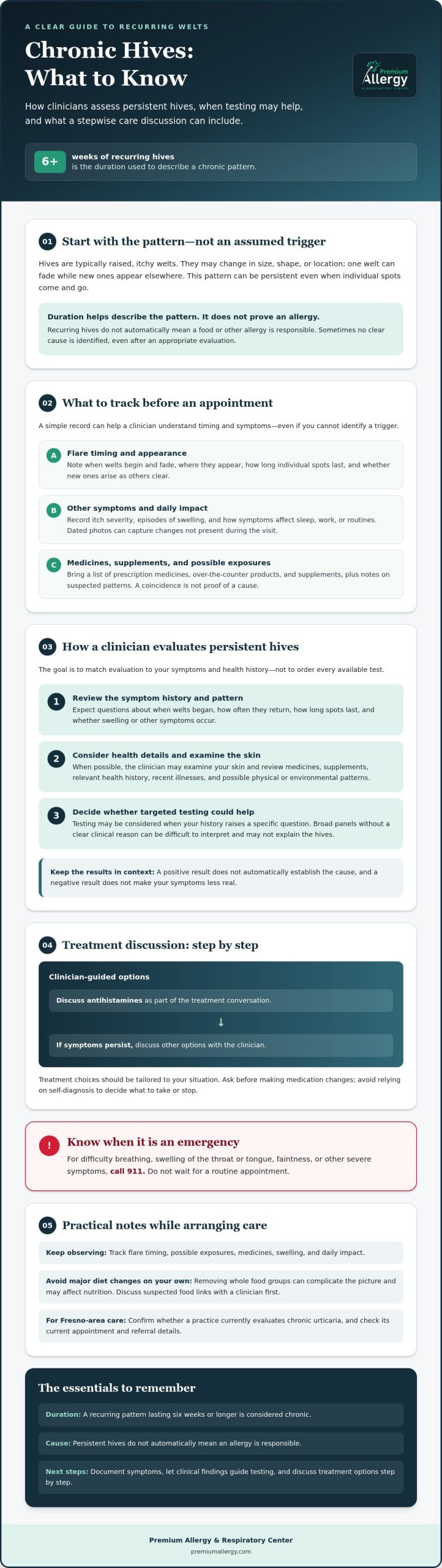
While arranging an evaluation, keep a simple record to help explain what’s happening and give a clinician useful details about the pattern. Tracking symptoms doesn’t replace medical care, but it can turn scattered observations into a clearer history. Continue following any treatment plan your clinician has already provided, and check with them before changing medicines or trying a new approach.
Use a notebook or private digital note to record when welts appear, how long they last, where they show up, and whether swelling occurs. Add itch severity and note any medicines you took, along with your response, as directed by the prescribing clinician. Dated photographs can help show changes between appointments. Store them securely, since skin photos may contain personal health information.
Keep the routine manageable. A brief entry after a flare is often more useful than trying to remember details later. Note possible patterns, such as timing around a particular activity or environment, without assuming they prove the cause or making major diet changes on your own.
Before arranging an appointment, contact the practice directly to ask whether it currently evaluates chronic urticaria and what information to bring. Confirm its location and any referral requirements with the clinic, and check insurance details with both the clinic and your insurer. Don’t assume a service, appointment, or coverage is available until you’ve checked.
Premium Allergy & Respiratory Center is a Fresno-based outpatient specialty practice serving Fresno, Clovis, Selma, and North Clovis. Its services include specialized allergy and respiratory care, but chronic hives evaluation isn’t explicitly confirmed. Verify that this concern is within the clinic’s current scope before planning a visit. Hives and eczema are different conditions, so a page about an Eczema Treatment Specialist in Fresno addresses a related but distinct skin-care topic.
Seeking chronic hives treatment Fresno care can start with a clear question and a concise symptom record. Contact the clinic to confirm whether it evaluates chronic hives and ask about current appointment, referral, and insurance details: contact the Fresno specialty practice.
Recurring hives can be evaluated even when you can’t identify what sets them off. An unknown trigger doesn’t make your symptoms less real or prevent a clinician from discussing ways to manage them. Start with the pattern: note how long symptoms have been recurring, document changes, arrange an evaluation, and review treatment options with a qualified clinician.
Bring a few questions to make the visit useful. Ask what your symptom pattern may suggest and whether targeted testing is appropriate. Discuss how you’ll assess treatment response, what medication effects to watch for, and when follow-up is recommended. You can also ask which symptoms call for urgent or emergency care, so you know what to do if your condition changes.
Hives often appear as raised, itchy areas that change or fade over time, while eczema, also called atopic dermatitis, commonly involves more persistent skin inflammation. These conditions can look different, but appearance alone isn’t enough to identify the cause. A persistent or unclear rash deserves an appropriate clinical assessment. For information about a distinct condition, see the practice’s Atopic Dermatitis Medical Treatment page.
To explore chronic hives treatment Fresno, first confirm that the provider you’re considering currently evaluates chronic urticaria. Premium Allergy & Respiratory Center is a Fresno-based outpatient allergy and respiratory specialty practice serving Fresno, Clovis, Selma, and North Clovis, but chronic-hives services aren’t explicitly confirmed. Ask directly about the clinic’s current scope, appointment details, referral requirements, and which records to bring. Confirm insurance information with the practice and your insurer.
If you’re considering this practice, contact Premium Allergy & Respiratory Center to ask whether it currently evaluates chronic hives and to verify appointment details. That check can help you choose an appropriate next step without assuming a diagnosis, a known trigger, or a particular treatment plan.
Recurring hives deserve attention, even when no trigger is obvious. A symptom record can help a clinician understand the pattern, while a focused evaluation can guide whether testing is useful. Treatment is often discussed step by step, with medication choices and changes guided by a clinician rather than guesswork.
If you’re exploring chronic hives treatment Fresno, Premium Allergy & Respiratory Center is a Fresno-based outpatient allergy and respiratory specialty practice serving Fresno, Clovis, Selma, and North Clovis. The practice provides specialized diagnostic and treatment services for allergic and complex conditions, but chronic-hives evaluation is not explicitly confirmed. Check its current scope and appointment details before making plans.
Contact Premium Allergy & Respiratory Center to ask about chronic-hives evaluation. A simple inquiry can help you understand whether this practice may be an appropriate next step. Keep documenting your symptoms and bringing your questions forward as you work toward a more informed care plan.
The best treatment depends on your symptoms, health history, and response to earlier care. Clinicians commonly begin with a second-generation H1 antihistamine, which targets histamine-related itching and welts. If symptoms remain uncontrolled, a clinician may adjust the plan or discuss specialist-directed options. Don’t change doses or combine medicines without guidance. Long-term use of systemic corticosteroids is generally discouraged because of potential risks.
Yes, hives can sometimes be linked to an identifiable trigger, including an allergic reactions exposure, but chronic hives aren’t always caused by an allergy. Chronic spontaneous urticaria describes recurring hives without a clear external trigger identified after evaluation. A clinician can review your symptom pattern and decide whether targeted testing makes sense. An unknown cause doesn’t mean the symptoms can’t be assessed or managed.
Hives are considered chronic when they recur for more than six weeks. That describes the overall pattern, not necessarily how long each individual welt stays in one place. Welts may fade as new ones appear, and the condition’s course varies from person to person. There isn’t one duration that applies to everyone. If recurring symptoms affect your sleep or routine, discuss the pattern with a clinician.
If symptoms continue despite antihistamines, a clinician can review your treatment, response, and possible side effects before recommending a next step. Depending on your diagnosis and circumstances, specialist-directed options may include omalizumab or other approved therapies. Some treatment plans require documentation of previous medication trials. Don’t increase doses or start prescription treatments on your own. Follow-up helps determine whether the plan is appropriate and needs adjustment.
Not everyone with chronic hives needs allergy testing. A clinician may recommend targeted testing if your history suggests a specific exposure or raises a particular clinical question. Broad testing without a clear reason may not explain the symptoms. A positive result doesn’t automatically prove what caused your hives, and a negative result doesn’t invalidate them. Share suspected patterns with your clinician before eliminating foods or changing your routine.
Consider specialist evaluation if hives keep recurring, last beyond six weeks, disrupt daily life, or remain uncontrolled with your current clinician-guided plan. For chronic hives treatment Fresno, ask whether a practice currently evaluates chronic urticaria and confirm appointment, referral, and insurance details. Premium Allergy & Respiratory Center serves Fresno, Clovis, Selma, and North Clovis, but its chronic-hives services aren’t explicitly confirmed. Breathing difficulty or throat or tongue swelling requires emergency care. Call 911.
No. Chronic hives involve recurring raised welts, while eczema, also called atopic dermatitis, is a distinct condition involving persistent skin inflammation. Both can itch, but they may require different evaluations and care. A rash’s appearance alone can’t confirm its cause, especially if it’s persistent or unclear. A clinician can assess the pattern and help determine what kind of care may be appropriate.
Could symptoms that flare around your pet have more than one explanation? Sneezing, itchy eyes, or congestion after time with an animal can raise a... Continue reading
READ MORE
Could a swollen, painful sting site mean something different from a dangerous allergic reaction? If you’re unsure what your symptoms meant or worried... Continue reading
READ MORE
What if the pollen, dust mites, or mold you suspect aren’t the whole story behind your symptoms? Environmental allergy testing can help identify... Continue reading
READ MORE
A positive allergy blood test doesn’t automatically mean a substance is causing your symptoms. The test measures specific immunoglobulin E (IgE)... Continue reading
READ MORE