
Could a sting that starts with a sore, swollen spot become an emergency? The difference often comes down to whether symptoms stay near the sting or... Continue reading
READ MORE

What if that stubborn cold you’ve been fighting since last October isn’t actually a virus at all? It’s more likely you’re dealing with perennial allergic rhinitis, a persistent condition where indoor triggers like dust mites, mold, or pet dander turn your sanctuary into a source of constant inflammation. You’ve probably spent months cycling through different over-the-counter medications, only to find the congestion returns the moment the dose wears off. It’s exhausting to live in a state of permanent cold that disrupts your sleep and drains your daily energy.
The good news is that you don’t have to settle for temporary fixes. We’re here to help you reclaim your vitality by separating fact from fiction regarding these year-round triggers. This article will debunk five common myths about chronic allergies and show you how specialized testing can finally provide the clarity you need for lasting relief. It’s time to stop guessing and start breathing clearly again.
Many people in Fresno spend months feeling like they’re just getting over a bug. You’ve probably said it yourself: “I’ve just had this stubborn cold I can’t shake.” If your congestion has overstayed its welcome for weeks or even months, you aren’t dealing with a virus. You’re likely experiencing perennial allergic rhinitis. Unlike seasonal allergies that flare up when almond blossoms or grasses hit their peak in the Central Valley, this condition is a chronic, IgE-mediated response to triggers that live right inside your home. Allergic rhinitis can be classified as either seasonal or perennial, with the latter persisting throughout the year because the allergens are constantly present in your environment. We believe you shouldn’t have to “just live with it.”
It’s easy to mistake chronic allergies for a winter cold, especially when the symptoms feel so similar. But there’s a major difference in the timeline. A typical cold usually runs its course in 7 to 10 days. If your nose is still stuffed after three weeks, it’s time to look closer. Pay attention to what’s missing, too. True viral infections often bring body aches, a sore throat, or a low-grade fever. If you only have the sniffles, itchy eyes, and constant sneezing, your immune system is likely reacting to an allergen rather than a germ. Tracking how long your symptoms last is your first step toward a real solution. You aren’t sick; you’re simply reacting to your surroundings.
Think of your immune system as a highly sensitive security system. In cases of perennial allergic rhinitis, that system starts treating harmless particles like dust mites, mold spores, or pet dander as dangerous invaders. This is a “false alarm” that triggers the release of histamine. Histamine is the chemical responsible for that familiar swelling, itching, and mucus production. When this inflammation becomes chronic, it doesn’t just make you uncomfortable; it can lead to secondary complications like heavy sinus pressure or even ear infections. You don’t have to accept this state of constant struggle. Specialized care can help you identify these silent enemies and reclaim your quality of life through precision diagnostics.
One of the most persistent myths we hear is that a pet-free home is an allergy-free home. While avoiding fur and feathers is a great start, it doesn’t grant you immunity from perennial allergic rhinitis. In reality, the most common trigger for year-round symptoms isn’t a cat or a dog; it’s the microscopic dust mite. These tiny organisms thrive in almost every household, regardless of how often you vacuum. Patients often search for information on Hay Fever (Allergic Rhinitis), but the triggers for year-round symptoms are often closer to home than a hay field.
In the Central Valley, our unique climate and reliance on cooling systems create specific challenges. Evaporative coolers and air conditioning units can harbor mold if not meticulously maintained. Even in “clean” homes, cockroach droppings and old pet dander can settle into the infrastructure. These particles are incredibly lightweight and become airborne the moment you turn on your heater or walk across a rug. If you feel like your symptoms spike the moment you step through your front door, your indoor air quality is likely the culprit.
Dust mites don’t bite, but their waste contains a protein that is a powerful allergen. They settle where they can find moisture and food, making your mattress, upholstered furniture, and thick carpets their primary residences. Standard cleaning often fails to reach these deep-seated colonies. To effectively manage this trigger, we recommend using allergen-proof zippered covers for your pillows and mattresses and investing in a vacuum with a certified HEPA filter to trap particles instead of blowing them back into the air. Taking charge of your environment starts with knowing exactly what you’re fighting, and specialized diagnostic testing can provide that precise roadmap.
Pet dander is notoriously “sticky” and can linger in a home for six months or longer after a pet has moved out. Similarly, mold can hide in Fresno home hotspots like under-sink cabinets, bathroom corners, or behind heavy furniture where air circulation is poor. During Central Valley winters, we tend to keep our windows tightly shut to stay warm. This lack of ventilation causes indoor air quality to drop significantly as these “invisible squatters” accumulate. When your immune system is constantly bombarded by these particles, your body stays in a state of high alert, leading to the chronic exhaustion and congestion you’re currently experiencing.
If you have ever searched for the link between allergic rhinitis and fever, you aren’t alone. The term “hay fever” is one of the most persistent misnomers in medical history. It suggests a temperature spike that simply doesn’t exist in the world of allergies. According to the American College of Allergy, Asthma & Immunology, allergic rhinitis is an immune system overreaction, not a viral or bacterial invasion. Because your body isn’t fighting a living pathogen, it doesn’t trigger your internal thermostat to rise. If you’re running a fever, you’re likely dealing with a cold, the flu, or a sinus infection, not your year-round triggers.
Your immune system is incredibly precise. It raises your body temperature specifically to kill off heat-sensitive viruses and bacteria. Harmless particles like dust mites or mold spores don’t care about a few degrees of warmth, so your body doesn’t bother with the heat. Understanding this distinction is empowering. It allows you to stop reaching for fever reducers and start looking for the specialized diagnostic answers that actually address the root of your discomfort.
Differentiating between an infection and perennial allergic rhinitis is easier when you know which “tells” to look for. While both can cause congestion, their secondary symptoms are worlds apart. Itchy, watery eyes and an itchy nose or throat are almost exclusive to allergies. In contrast, infections often bring a heavy sense of fatigue, body aches, and a sore throat. You should also pay attention to your mucus. Clear, watery discharge is the hallmark of an allergic response. Thick, yellow, or green mucus usually indicates that your body is actively battling a germ. If your symptoms are “itchy” rather than “achy,” allergies are the likely culprit.
Even though allergies don’t cause a fever, they can certainly make you feel like you have a “sinus infection.” Chronic inflammation from perennial allergic rhinitis causes the delicate tissues in your nasal passages to swell. This swelling blocks the natural drainage of your sinuses, leading to intense pressure, headaches, and facial tenderness. Many patients cycle through rounds of antibiotics for what they believe are recurring infections, when the real issue is untreated inflammation. Breaking this cycle requires moving beyond general care. By identifying your specific indoor triggers through professional testing, you can stop the swelling before the pressure ever starts. You don’t need a generalist to manage a cold; you need a specialist to help you reclaim your vitality.
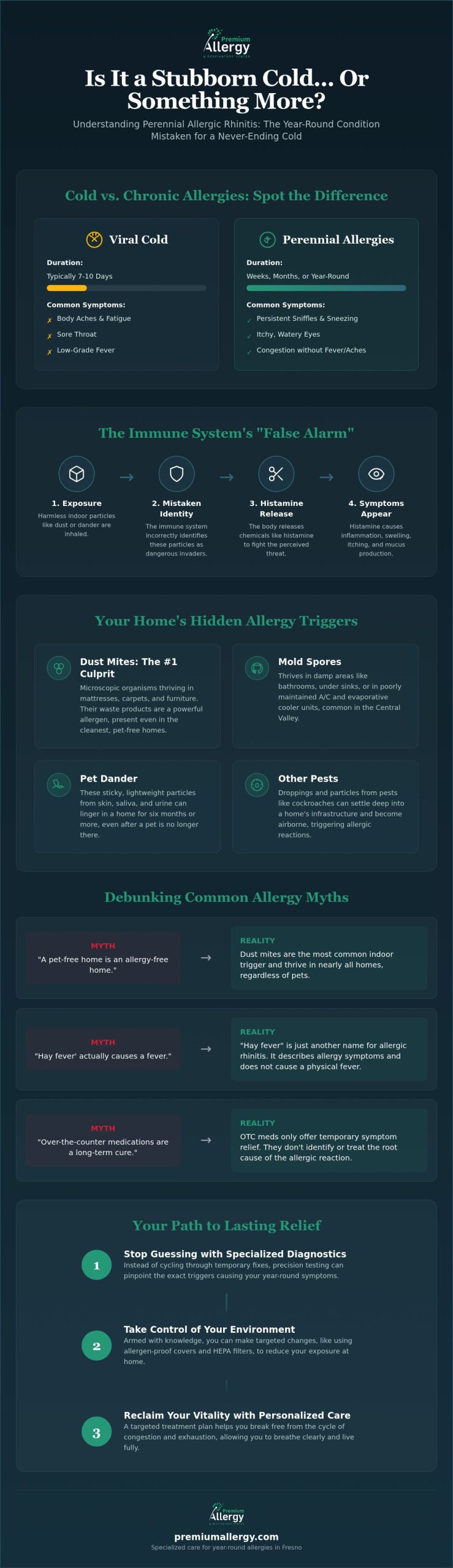
You’ve likely spent a small fortune on drugstore shelves, hoping each new box holds the secret to clear breathing. It’s a cycle many people with perennial allergic rhinitis know too well. You grab a spray or a pill, feel better for a few hours, and then the congestion returns with a vengeance. These over-the-counter (OTC) options are essentially medical band-aids. They mask the symptoms without ever addressing the root cause of your immune system’s overreaction. While they might help you get through a single afternoon, they aren’t designed to provide a lifetime of vitality. True freedom from allergies comes from precision, not from a generic, one-size-fits-all product.
Many patients find that their go-to antihistamines seem to lose their punch after a few months. This isn’t your imagination; your body can become accustomed to the medication, leaving you frustrated and still congested. Even more concerning is the “rebound effect” known as rhinitis medicamentosa. This occurs when you use certain decongestant nasal sprays for more than three days. Your nasal tissues become dependent on the chemical to stay open, leading to even more severe swelling once the medicine wears off. You’re left in a state of constant struggle, trapped by the very thing meant to help. Breaking this cycle requires a shift from guessing to knowing. Through blood allergy testing, we can pinpoint your exact triggers, allowing for a precision-guided treatment plan that OTC products simply can’t match.
Instead of just quieting your symptoms, we focus on retraining your immune system to behave differently. Immunotherapy is a sophisticated approach that gradually builds your tolerance to the very things that make you miserable. It’s the difference between wearing a raincoat every day and actually stopping the storm. By introducing tiny, controlled amounts of your specific allergens, your body eventually learns to stop viewing them as threats. This isn’t just about feeling better tomorrow; it’s about a future where you don’t have to plan your life around a pill bottle. You can achieve a state of lasting vitality where your home environment no longer dictates your comfort. If you’re ready to move past temporary fixes, it’s time to schedule a specialized clinical evaluation and start your journey toward permanent relief.
Living in the Central Valley means dealing with more than just the occasional seasonal pollen spike. The unique air quality challenges in Fresno, Clovis, and Selma mean that your indoor environment is constantly under siege from fine dust and agricultural particles. For many residents, this leads to a persistent state of perennial allergic rhinitis that never seems to take a day off. You deserve a medical partner who understands the local landscape and the specific ways it affects your respiratory health. We don’t just treat symptoms; we help you master your environment.
Our region is famous for its agricultural productivity, but that same environment creates a heavy load of microscopic triggers that settle deep within your home. These aren’t just generic allergens; they’re Central Valley specific. Whether it’s the fine silt from local fields or the specific molds that thrive in our valley’s cooling systems, your symptoms are a direct reaction to your immediate surroundings. General practitioners might treat the surface congestion, but a specialist understands how our local climate shapes your internal immune response. We provide the localized expertise that general care simply cannot offer. With convenient locations across Fresno, Clovis, and Selma, expert help is always within reach for those tired of the “Central Valley sniffle.”
Your journey toward breathing clearly begins with a fundamental shift in perspective. At Premium Allergy & Respiratory Center, we don’t view your symptoms as a mystery to be managed, but as a puzzle to be solved with clinical precision. During your comprehensive evaluation, we utilize specialized diagnostic tools, including blood allergy testing, to identify the exact source of your inflammation. This isn’t a “wait and see” approach. We move quickly to create a personalized management plan that targets the root cause of your perennial allergic rhinitis.
This precision-guided methodology is designed to move you from a state of frustration to one of action. Relief isn’t just a lucky break; it’s the expected result of modern, expert intervention. By combining scientific advancement with an empathetic, human approach, we help you reclaim your home as a sanctuary. You can schedule your specialized evaluation at Premium Allergy today and start your path toward lasting vitality. You’ve lived with the struggle long enough; it’s time to start living with clarity.
Living with constant congestion isn’t just a minor inconvenience; it’s a barrier to the high-quality life you deserve. We’ve debunked the myths that keep many people trapped in a cycle of “stubborn colds” and temporary fixes. By understanding that perennial allergic rhinitis is a manageable immune response to indoor triggers, you can finally stop guessing and start healing. True relief comes from moving beyond the pharmacy aisle and seeking the precision that only a specialist can provide.
Our team offers specialized blood allergy testing for Fresno, Clovis, and Selma residents, ensuring you receive an expert diagnosis tailored to our unique Central Valley environment. We’re dedicated to helping you build a personalized treatment plan that targets the root cause of your chronic respiratory issues. You don’t have to settle for another season of struggle. It’s time to take charge of your health and embrace a future filled with energy and clear breathing. Breathe easier year-round with a specialized evaluation at Premium Allergy & Respiratory Center. We’re ready to be your modern ally in the pursuit of lasting well-being!
Perennial allergic rhinitis is a chronic condition, but it doesn’t have to be a permanent sentence of suffering. While the sensitivity remains in your genetic makeup, specialized treatments like immunotherapy can effectively retrain your immune system. By gradually building your tolerance to indoor triggers, we can move you from a state of constant congestion to a future of clear breathing. You have the power to change how your body responds to your environment.
You can absolutely develop perennial allergies suddenly as an adult. It’s a common misconception that allergies only start in childhood. Changes in your immune system, a move to a new home in Fresno, or even long-term exposure to certain indoor triggers can spark a new sensitivity. If you find yourself suddenly struggling with chronic cold symptoms, it’s often your body finally reaching a breaking point with a specific allergen.
The primary difference lies in the immune system’s involvement. Perennial rhinitis is an IgE-mediated allergic response where your body attacks harmless proteins like dust mites. Non-allergic rhinitis involves nasal inflammation triggered by irritants like strong perfumes, cigarette smoke, or weather changes without an underlying allergy. Distinguishing between the two requires specialized testing to ensure you aren’t wasting time on treatments that don’t address the actual cause of your daily discomfort.
In Fresno, adding a humidifier often does more harm than good for allergy sufferers. Dust mites and mold spores thrive in moist environments. While our Central Valley air can feel dry, keeping your indoor humidity below 50 percent is essential for controlling these specific triggers. Instead of a humidifier, we recommend focusing on high-quality air filtration to remove the particles that are actually causing your chronic inflammation and heavy nasal pressure.
No, perennial allergic rhinitis does not cause a fever or chills. These symptoms are the hallmark of a viral or bacterial infection, such as the flu or a cold. Your body raises its temperature specifically to kill living pathogens, but it doesn’t use heat to fight harmless allergens like pet dander. If you’re experiencing a fever alongside your congestion, you should look for an underlying infection rather than just an allergic flare.
For most patients in Clovis and Selma, specialized blood allergy testing is the most efficient and accurate diagnostic tool. This method measures the specific IgE antibodies in your system to pinpoint exactly which indoor triggers are causing your symptoms. Unlike some older methods, blood testing is highly precise and doesn’t require you to stop taking your current antihistamines. It provides the clear, scientific roadmap needed to create your personalized path toward relief.
It’s very common to have both seasonal and perennial allergic rhinitis simultaneously. This is often referred to as perennial rhinitis with seasonal exacerbations. You might experience a baseline of stuffiness year-round due to dust mites, only to have your symptoms skyrocket when local Fresno pollen counts rise in the spring. Identifying both sets of triggers is vital for creating a comprehensive management plan that protects your vitality through every month of the year.
Most patients begin to notice a significant improvement within six months to a year of starting immunotherapy. While this isn’t an overnight fix, it’s a permanent solution that addresses the root cause of your allergies. The initial build-up phase focuses on safely increasing your tolerance, leading to a maintenance phase where your symptoms naturally fade. This journey requires patience, but the result is a life free from the daily struggle of congestion.
Could a sting that starts with a sore, swollen spot become an emergency? The difference often comes down to whether symptoms stay near the sting or... Continue reading
READ MORE
Could symptoms that flare around your pet have more than one explanation? Sneezing, itchy eyes, or congestion after time with an animal can raise a... Continue reading
READ MORE
Could a swollen, painful sting site mean something different from a dangerous allergic reaction? If you’re unsure what your symptoms meant or worried... Continue reading
READ MORE
What if the pollen, dust mites, or mold you suspect aren’t the whole story behind your symptoms? Environmental allergy testing can help identify... Continue reading
READ MORE