
One food challenge doesn’t fit every allergy: an oral food challenge with an allergist in Selma is tailored to the suspected allergy, your medical... Continue reading
READ MORE

A methacholine challenge test in Fresno measures how your airways respond to methacholine, rather than relying only on how you feel. You inhale a mist in gradually increasing doses while spirometry checks for changes in your breathing. Airway narrowing can help clinicians assess asthma, particularly when symptoms or other test results have not provided a clear answer.
It’s understandable to want to know what the test may feel like and how to prepare. The process is monitored, and inhaled medicine can help relieve symptoms if your airways tighten. Knowing what to expect can make the experience feel more manageable.
Here’s what the test measures, how the stages work, which medicines may need to be paused, and what symptoms can occur. You’ll also learn what the results may indicate and what to consider before your appointment.
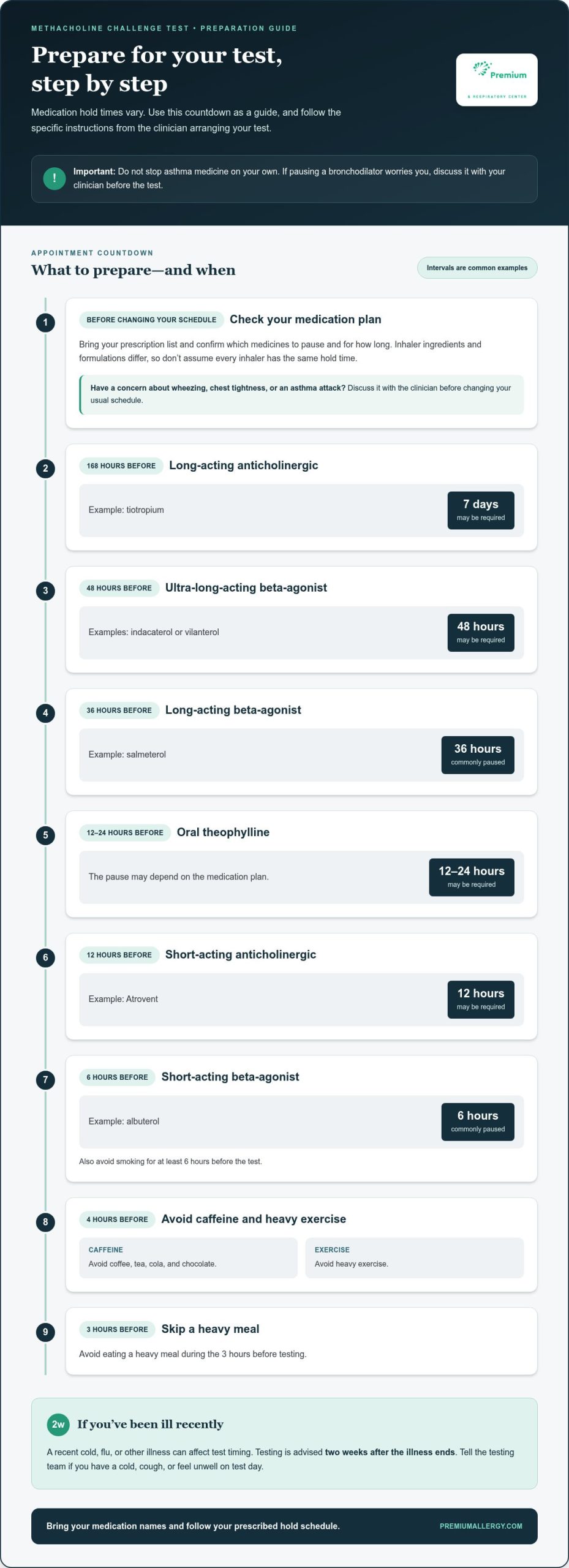
Medication timing can affect this pulmonary breathing test, so bring your prescription list and follow your appointment instructions. Some inhalers reduce airway narrowing and can change how methacholine affects your breathing. Don’t stop asthma medicine on your own. Follow the specific instructions from the clinician arranging the test, and clarify any uncertainty before changing your usual schedule.
Common withholding intervals vary by medicine:
These examples don’t replace your own medication plan. Inhaler ingredients and formulations differ, and the recommended pause can depend on the medicine. Continue medicines as instructed rather than assuming every inhaler has the same hold time. If pausing a bronchodilator raises concerns about wheezing, chest tightness, or an asthma attack, discuss them before the test.
Plan the rest of your preparation around the appointment time. Avoid caffeine, including coffee, tea, cola, and chocolate, for at least 4 hours beforehand. Avoid heavy exercise for at least 4 hours, and don’t eat a heavy meal during the 3 hours before testing. Don’t smoke for at least 6 hours before the test.
Tell the testing team if you feel unwell or have a cold or cough on test day. A recent cold, flu, or other illness can affect the timing; testing is advised two weeks after the illness ends. Bring your medication names and follow the prescribed hold schedule so the result can be interpreted accurately.
A methacholine challenge can briefly affect your breathing as doses increase. Understanding possible reactions and safety factors can help you know what to report during testing.
This bronchoprovocation test may temporarily tighten the airways, causing coughing, wheezing, shortness of breath, chest tightness, dizziness, or chest discomfort. You may notice changes after inhaling a dose, while spirometry measures your breathing function. Tell the testing team promptly about any symptoms, even if they seem mild.
For example, coughing or tightness may accompany a decrease in lung function. If your airways constrict, the team may give inhaled bronchodilator medicine to relieve symptoms. Your breathing is assessed throughout the test, so describe what you feel as it happens rather than waiting until the procedure ends.
People who are pregnant or nursing, have uncontrolled high blood pressure, or have an aortic or brain aneurysm should not have this test. A heart attack or stroke within the previous 3 months is also a reason not to perform it. The test may be unsuitable when baseline spirometry shows FEV1 below 60% of expected or below 1.5 liters.
These factors matter because methacholine deliberately challenges airway response, and low starting lung function can affect whether testing is appropriate. Share relevant health conditions before your appointment, including a recent heart attack or stroke, and report if you feel unwell on test day. A cold or cough can affect timing, so tell the testing team if you have those symptoms.
Follow each instruction during testing and clearly describe any new reaction. Coughing, wheezing, dizziness, or shortness of breath can help explain how your airways respond. If chest tightness or discomfort develops after an inhaled dose, tell the team promptly so they can assess your symptoms and decide whether to continue or give inhaled medicine.
This bronchoprovocation test checks whether inhaled methacholine makes your airways narrow. It can help assess asthma when symptoms or other findings leave the diagnosis unclear.
A bronchodilator is inhaled medicine that eases airway narrowing and relieves symptoms. If methacholine causes airway constriction, the testing team may give this medicine to help your breathing return toward normal.
This step matters if you develop coughing, wheezing, or shortness of breath during testing. Your response to methacholine provides information about airway reactivity; the bronchodilator addresses symptoms. Receiving it is part of managing a test reaction and does not, by itself, diagnose asthma.
Bronchial hyperresponsiveness describes how readily airways narrow in response to methacholine. Results may be classified using PC20, the concentration associated with a measured breathing change.
A PC20 of 8 mg/mL or less is considered positive, while a result above 16 mg/mL is considered negative. Results from 4.0 to 16 mg/mL fall into the borderline category; 1.0 to 4.0 mg/mL indicates mild hyperresponsiveness, and below 1.0 mg/mL indicates moderate to severe hyperresponsiveness. These categories describe airway response, not symptoms alone.
Methacholine testing adds evidence about airway reactivity, but no single result explains everyone’s symptoms. A negative result makes asthma less likely; a positive result can also occur in people without asthma, so results need to be considered in clinical context.
In Fresno, referral or prescription requirements depend on the testing facility’s ordering process. Insurance coverage and billing codes also depend on the plan and billing circumstances, so no single answer or code applies to everyone.
Consider the result alongside your symptoms and other breathing-test findings. This fuller picture can guide asthma-care decisions without treating one measurement as a complete diagnosis.
The test compares your breathing before and after methacholine exposure. For a methacholine challenge test in Fresno, pulmonary function measurements show whether your airways respond to the inhaled substance.
First, spirometry establishes your baseline lung function. You breathe into a testing device that measures how much air you can move and how quickly. Later readings are compared with this starting measurement, not with a general impression of whether breathing feels normal. This provides a reference point for tracking changes.
Next, you inhale a mist containing a small dose of methacholine. Spirometry is repeated after each dose, then the dose increases in stages. FEV1, a measurement of air exhaled forcefully, is checked 30 seconds and 90 seconds after inhalation. The sequence continues while the team tracks whether your airways become more responsive.
The test may stop when FEV1 falls by more than 20% compared with baseline, or when the maximum dose is reached without that change. A decrease of 20% or greater meets the test’s positive response threshold. This measured comparison is the central takeaway: the result reflects a change in pulmonary function after controlled exposure, rather than symptoms alone.
A methacholine challenge test typically takes 30 to 90 minutes. The exact duration depends on how your lung function responds across the dose sequence and whether the test reaches its stopping point early. Exercise can also affect breathing measurements, which is why preparation instructions matter before testing. The repeated readings let the team follow changes instead of relying on one isolated result.
If you’re considering a methacholine challenge test in Fresno because of breathing symptoms, discuss your asthma concerns and how pulmonary function testing may fit your evaluation.
Premium Allergy offers Asthma Management for people seeking guidance after an asthma evaluation or help managing ongoing symptoms. A methacholine challenge test provides information about airway responsiveness; follow-up care can put that information in context with your symptoms and asthma concerns.
If nasal congestion, sneezing, or other allergy symptoms affect your breathing comfort, Allergic Rhinitis Treatment may also be relevant. The right care depends on the concern you’re addressing, whether asthma symptoms or allergic rhinitis. Knowing what the test measures gives you a clearer starting point for discussing next steps.
For a conversation about asthma or allergy care, contact Premium Allergy & Respiratory Center or visit premiumallergy.com.
Use your test results to start a clearer conversation about breathing symptoms and ongoing care. If you’re preparing for a methacholine challenge test in Fresno, note when symptoms arise and what seems to affect them. These observations can help focus your follow-up discussion.
Premium Allergy & Respiratory Center offers Asthma Management, Allergic Rhinitis Treatment, and Food Allergy Testing. These services address different concerns, so the right next step depends on the questions you want to explore with an allergy and respiratory specialist. Bring your test experience and questions about your symptoms to that discussion.
Whenever you’re ready to talk through allergy or asthma care, contact Premium Allergy & Respiratory Center. Taking one informed step at a time can help you move forward with greater clarity.
The main risks involve airway narrowing and health conditions that can make the challenge unsuitable. The test should not be performed during pregnancy or nursing, with uncontrolled high blood pressure, or with an aortic or brain aneurysm. A heart attack or stroke within the previous three months is also a reason to avoid it. Very low baseline lung function may make testing unsuitable.
The procedure measures airway response to inhaled methacholine using pulmonary function testing. In addition to tracking FEV1, testing may use specific airway conductance, or SGaw, as a measurement. If SGaw is used, the test may continue until it reaches 35 to 40 percent; a positive response is indicated by 100 mcg or less, or 4 mg/mL or less.
Use the medication hold schedule provided for your test, because timing varies by drug. Common examples include pausing short-acting inhaled beta-agonists such as albuterol 6 hours beforehand, long-acting beta-agonists such as salmeterol 36 hours beforehand, and ultra-long-acting medicines such as vilanterol 48 hours beforehand. Tiotropium may require a 168-hour pause. Don’t change prescribed medicines without the test team’s instructions.
The appointment usually takes 30 to 90 minutes. You inhale methacholine in increasing doses, with breathing measurements taken after each dose to track airway response. After testing, you can eat, drink, and return to your usual routine. You may be asked to remain for an hour or longer before going home, allowing staff to observe your recovery.
Temporary reactions may include coughing, wheezing, shortness of breath, chest tightness, dizziness, or chest discomfort. Tell the testing team if any symptom begins or worsens during a dose. If airway constriction occurs, inhaled medicine may be given to relieve symptoms. The team uses your breathing measurements and reported symptoms to guide the test and determine when to stop.
One food challenge doesn’t fit every allergy: an oral food challenge with an allergist in Selma is tailored to the suspected allergy, your medical... Continue reading
READ MORE
A methacholine challenge test in Fresno measures how your airways respond to methacholine, rather than relying only on how you feel. You inhale a... Continue reading
READ MORE
Breathing symptoms tell part of the story; measured airflow adds another. A spirometry test for asthma in Clovis measures how much air you can force... Continue reading
READ MORE
A skin allergy patch test in Fresno is a multi-visit process, not a single appointment. Allergens are placed on the skin on Day 1; the panels are... Continue reading
READ MORE