
A methacholine challenge test in Fresno measures how your airways respond to methacholine, rather than relying only on how you feel. You inhale a... Continue reading
READ MORE

Breathing symptoms tell part of the story; measured airflow adds another. A spirometry test for asthma in Clovis measures how much air you can force out in one second and the total volume you exhale in a single breath. The results can reveal narrowed airflow and whether it improves after a bronchodilator, providing useful clues when assessing asthma.
If you’re dealing with wheezing, chest tightness, a persistent cough, or shortness of breath, it’s natural to want clear answers. Spirometry gives your healthcare provider objective measurements to consider alongside your symptoms, medical history, and physical exam, but one result doesn’t always settle the question. You’ll learn what the test measures, how providers interpret FEV1 and FVC, and how changes after a bronchodilator can inform an asthma assessment. We’ll also explain how spirometry can help distinguish asthma from other lung conditions and guide decisions about ongoing care.
Pulmonary function testing measures how effectively your lungs move air during breathing. For asthma, spirometry can show airflow limits and whether measurements change after medication.
Pulmonary function testing measures how much air you breathe out and how quickly it leaves your lungs. These readings give a healthcare provider objective information to consider alongside your symptoms and medical history. Asthma can narrow the airways, and other conditions can also affect airflow, so test results are only part of the assessment.
Bronchodilator testing compares breathing measurements before and after inhaled medicine designed to open the airways. You complete spirometry, take the medicine, then repeat the measurements. Improved airflow afterward can support an asthma assessment. A spirometry test for asthma in Clovis may include this comparison when a provider needs to see how airflow responds to medication.
Spirometry standards published by the American Thoracic Society address test quality and consistent measurements. During testing, you may need to blow hard and fast several times, which can briefly cause coughing, lightheadedness, or shortness of breath. Tell the technician if you feel discomfort. Before testing, tell your healthcare professional about a recent heart attack, chest, abdominal, or eye surgery, a collapsed lung, or tuberculosis.
Does insurance cover spirometry testing for asthma in Clovis? Coverage depends on your health plan and the reason for testing. Review your plan’s benefits for outpatient pulmonary function testing.
How should you prepare, including whether to stop inhalers? Follow your healthcare professional’s instructions about inhalers; don’t stop or change them on your own. Wear loose clothing, avoid a large meal within two hours, vigorous exercise within 30 minutes, smoking for one hour, and alcohol within four hours before testing.
Spirometry provides objective measurements that can help explain breathing symptoms and guide further assessment. It can help distinguish asthma from other lung conditions, but providers interpret the readings alongside your symptoms and medical history.
Two key measures are FEV1 and FVC. FEV1 records the amount of air you can force out in one second; FVC measures the total air exhaled during a forceful breath. Together, they show how much air moves and how quickly. A doctor compares these results with your clinical picture, rather than treating one reading as a diagnosis. The pattern can indicate restricted airflow, while a normal result doesn’t always rule out asthma.
Asthma symptoms and airflow can vary, so spirometry may appear normal between episodes. If symptoms still suggest asthma, a healthcare professional may consider another assessment, such as a methacholine challenge or exercise test. A change in airflow after a bronchodilator can also support asthma, while persistent breathing problems require broader evaluation. These findings help differentiate possible causes without relying on cough or wheezing alone.
Chronic obstructive pulmonary disease, or COPD, is another condition that can affect airflow. People over 40 who smoke or used to smoke may have COPD, so that history can matter when interpreting lung function. Spirometry helps providers assess the airflow pattern, while age, smoking history, symptoms, and examination contribute to the overall picture. No single detail replaces the full clinical assessment.
Other information can sharpen the assessment. Providers may combine spirometry with peak flow measurement, allergy testing, a physical examination, and a review of your medical history. For example, symptoms that occur around allergy triggers can give useful context alongside measured airflow. If respiratory symptoms and allergic triggers overlap, asthma management can be part of a coordinated care discussion.
Tracking lung function over time adds another perspective. Comparing results can show whether lung function is changing and whether medication is helping control breathing problems. People with chronic lung disease may need lung function tests every year. Changes between assessments can inform discussions about treatment and next steps.
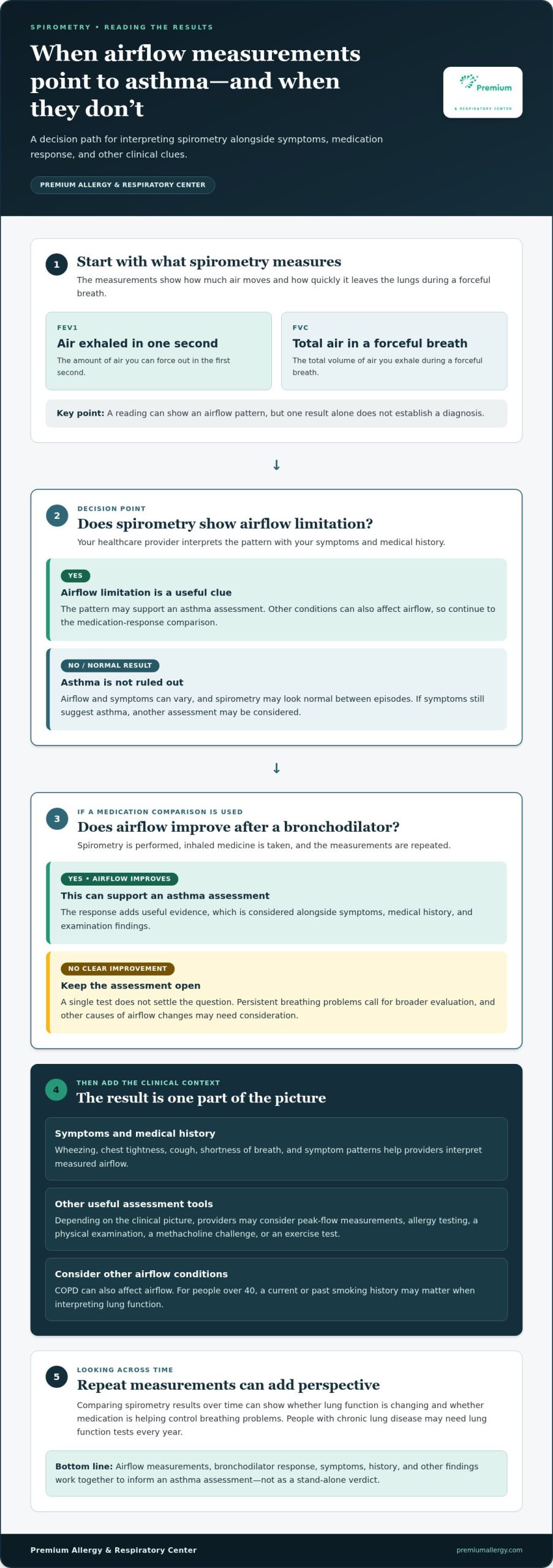
Spirometry provides objective measurements that can help assess possible asthma. Providers interpret the readings alongside your symptoms and examination to guide diagnosis and care.
Are there alternatives to spirometry for diagnosing asthma in Clovis? Yes. Peak-flow measurements, a methacholine challenge, or an exercise test may contribute to an asthma assessment when spirometry alone doesn’t provide enough information.
Do I need a referral to get spirometry in Clovis? Referral requirements are administrative, not part of the lung function test itself. They vary by clinic and insurance plan.
Spirometry supports an asthma assessment by showing whether airflow is limited and how it responds to bronchodilator medication. A provider considers this evidence alongside symptoms such as wheezing or chest tightness. A normal reading can occur in someone with asthma, so results need to be interpreted in context. Further assessment may help clarify the picture if symptoms or treatment change.
An asthma assessment draws on more than one test. A healthcare provider may consider peak-flow readings, allergy testing, a physical examination, and your medical history. For example, symptoms around allergy triggers provide useful context for interpreting lung function. If spirometry is normal but symptoms continue, a methacholine challenge or exercise test may add information.
Once the findings are reviewed, the provider uses the overall assessment to guide treatment planning. Spirometry results can inform choices about inhalers, medication strength, allergy care plans, and asthma management. Later measurements offer a comparison point: providers can assess whether lung function is changing and whether medication is helping control breathing problems. Share changes in symptoms between visits, since those details add context to test results.
A pulmonary function test turns breathing effort into measurements that providers can compare with respiratory symptoms. If you experience wheezing during exercise, recurring cough, or chest tightness around allergy triggers, spirometry can measure how quickly air moves and how much you can force out.
During testing, you sit upright, wear a nose clip, take a deep breath, then blow forcefully into a mouthpiece connected to a spirometer. The device records airflow and exhaled volume. Forced vital capacity, or FVC, is the largest amount of air you can force out after inhaling as deeply as possible. These readings make lung function more concrete than symptoms alone.
You’ll perform the breathing maneuver at least three times so the technician can assess whether the results are consistent. Strong, complete efforts matter: a hesitant start or incomplete breath can affect the measurement. The technician may coach your technique and repeat attempts to capture reliable results. Tell them if coughing or discomfort interrupts a blow.
For a bronchodilator comparison, the provider first records spirometry measurements, then gives inhaled medication. After waiting 15 minutes, you complete another set. Improved airflow after medication supports an asthma assessment. Comparing the two sets helps connect symptoms with a measurable change in breathing, rather than treating one isolated reading as the whole answer.
Spirometry is described as a safe, painless test, though forceful breathing can briefly cause dizziness, lightheadedness, or coughing. Tell the technician if you feel unwell during the test. Results are considered alongside your symptom pattern and medical history. If cough, wheezing, or tightness continues, discuss how asthma management can address symptoms and guide follow-up care.
Premium Allergy & Respiratory Center provides Asthma Management and Allergic Rhinitis Treatment for people seeking help with respiratory or nasal allergy symptoms. If breathing symptoms occur alongside sneezing, congestion, or other allergy concerns, discussing the full pattern can help inform your care.
Spirometry results are one part of an asthma assessment. Bring questions and details about when symptoms appear, such as during exercise or around suspected triggers, to support a focused conversation about next steps. Premium Allergy also provides Food Allergy Testing and Penicillin Allergy Testing.
To discuss asthma or allergic rhinitis care, contact Premium Allergy & Respiratory Center in Fresno. In-person appointments and virtual consultations are available.
A spirometry test for asthma in Clovis can be one part of understanding respiratory symptoms. The next step is to connect the results with how breathing affects your day. Keep track of when symptoms arise, what seems to trigger them, and how they change. Those observations can help guide a focused discussion about care.
Bring your questions to that discussion, especially if symptoms continue or interfere with your routine. You can talk about how test findings fit your experience and what follow-up may help clarify next steps. If allergy concerns accompany your breathing symptoms, mention those too so they can be considered as part of your care.
For support with respiratory and allergy care, contact Premium Allergy & Respiratory Center. A thoughtful next conversation can help you turn test information into a clearer path forward.
Spirometry is a breathing test that records airflow and the amount of air you exhale. It gives your healthcare provider measurements to review alongside concerns such as breathlessness during activity or a recurring cough. For people in Clovis, it can be one part of assessing respiratory symptoms, not a standalone explanation for every cause of breathing difficulty.
You follow the technician’s instructions to breathe into a connected device. Careful effort helps produce useful readings, and the test may include a comparison after bronchodilator medicine. Before your appointment, tell the medical team about health concerns that could affect forceful breathing, such as recent surgery or a collapsed lung. Follow their medication instructions rather than changing inhaler use yourself.
A peak-flow meter provides a narrower snapshot: you blow into it, and the best of three successive readings is recorded. Spirometry captures additional lung-function measurements, giving clinicians more detail than peak flow alone. A home reading can help track day-to-day changes, while a clinical test can add information during an assessment of breathing symptoms.
Whether repeat testing is useful depends on why the first test was done and what changes in your symptoms, lung function, or treatment. People with chronic lung disease may need lung function tests every year. New breathing difficulties or a treatment review may also lead a provider to consider another measurement, so note meaningful changes between appointments.
Spirometry can help assess asthma, COPD, and other conditions that affect breathing. Its measurements can be compared over time to monitor changes in lung function and whether medication is helping control breathing problems. If symptoms continue despite treatment, updated results can contribute useful evidence to a clinical review.
People experiencing shortness of breath, persistent cough, wheezing, chest tightness, recurring bronchitis, or breathing symptoms around allergy triggers may be assessed with spirometry. A spirometry test for asthma in Clovis can help providers evaluate these symptoms using measured lung function. Very young children, particularly those under 5-6 years old, usually cannot perform the test reliably, so age and ability to follow instructions matter.
A methacholine challenge test in Fresno measures how your airways respond to methacholine, rather than relying only on how you feel. You inhale a... Continue reading
READ MORE
Breathing symptoms tell part of the story; measured airflow adds another. A spirometry test for asthma in Clovis measures how much air you can force... Continue reading
READ MORE
A skin allergy patch test in Fresno is a multi-visit process, not a single appointment. Allergens are placed on the skin on Day 1; the panels are... Continue reading
READ MORE
Breathing symptoms that keep returning deserve timely attention, particularly when they disrupt sleep, activity, or everyday routines. If you’re... Continue reading
READ MORE