
A body-wide reaction can look like several unrelated problems at once. Mast cell activation syndrome (MCAS) occurs when mast cells release mediators... Continue reading
READ MORE

Symptoms alone can’t confirm EoE. For adults seeking EoE treatment in Clovis, diagnosis requires an upper endoscopy with esophageal biopsies, which are examined for eosinophils. The clinician considers these findings alongside your symptoms, including whether gastroesophageal reflux disease could be contributing.
If swallowing feels difficult or food seems to stick, it’s understandable to want a clear explanation and a plan that fits daily life. EoE care may involve dietary changes, medication, and ongoing monitoring, with treatment tailored to inflammation and symptoms.
This guide explains how diagnosis works, what elimination diets can involve, and why reassessment matters over time. It also describes how allergy specialists and dietitians can help connect food-related concerns with a practical approach to managing EoE.
Dietary therapy may reduce eosinophilic inflammation by removing suspected food triggers. The approach can be gradual, with follow-up testing informing next steps.
Dietary elimination removes foods suspected of triggering EoE inflammation. Because reactions can take days to appear, identifying the responsible ingredient can be difficult. Milk, wheat, eggs, and soy are common triggers. Skin, blood, and patch allergy tests don’t reliably identify EoE triggers, so dietary changes need to be assessed differently.
Some plans begin by removing dairy alone, then expand the restrictions if inflammation persists. This staged approach can limit unnecessary changes while the response is assessed.
An empiric six-food elimination diet removes milk, wheat, eggs, soy, peanuts and tree nuts, and fish and shellfish, without relying on allergy-test results to select foods. A repeat upper endoscopy with biopsies after 6 to 8 weeks can assess inflammation. If it improves, foods are typically reintroduced one at a time, with follow-up endoscopies helping identify triggers.
Other plans may start by removing fewer foods. An elemental diet replaces ordinary foods with an amino-acid formula; it’s generally reserved for children with multiple triggers who haven’t responded to other treatments, not as the usual starting approach for adults.
Costs vary according to the evaluation and treatment involved. Insurance coverage depends on your plan’s benefits and the services provided.
If EoE-related narrowing causes food to stick or makes swallowing difficult, endoscopic dilation may stretch the narrowed area. It can ease swallowing but doesn’t treat inflammation. Dilation carries a perforation risk; gradual increases of about 3 mm per session may reduce that risk, with the diameter increased toward 16 mm.
Adult EoE symptoms can affect eating and comfort, but they don’t establish a diagnosis. A gastroenterologist considers symptoms alongside endoscopy and biopsy findings.
Difficulty swallowing, or dysphagia, means food doesn’t pass easily through the esophagus. Adults with EoE may notice this most with dry or dense solid foods, such as bread or meat. Repeated swallowing trouble can point to inflammation or narrowing, even when meals remain manageable. During an evaluation, describe which foods cause difficulty and how often it happens.
Chest pain, heartburn, and upper abdominal pain can also occur. These symptoms overlap with other conditions, including acid reflux, so they can’t identify EoE on their own.
Food sticking is the sensation that a bite has paused in the esophagus; an impaction occurs when food becomes lodged. Adults may notice this with dense solids, making eating feel unpredictable. Tell the gastroenterologist when it happens, which foods are involved, and whether swallowing trouble is changing. Food sticking can signal EoE or another swallowing disorder and warrants medical evaluation.
Untreated inflammation can contribute to an esophageal stricture, a narrowing that may make swallowing harder. Endoscopy with biopsies helps assess EoE; symptoms alone aren’t enough. Depending on the evaluation, care may include a topical treatment or dietary approach.
Dupilumab is an FDA-approved EoE treatment option for adults. Its cost varies with insurance coverage and individual benefits, so there is no single cost for every patient.
Follow-up endoscopy with biopsies is recommended 8 to 12 weeks after treatment begins or after a major treatment change. For selected patients, repeat endoscopy may be considered every 12 to 24 months. These assessments check tissue inflammation, which symptoms may not fully reflect.
EoE is a chronic disease, so care involves more than responding to swallowing symptoms. Coordinated care connects the gastroenterologist’s assessment with allergy expertise and practical support for eating.
After diagnosing EoE, a gastroenterologist may refer you to an allergist. An allergist or immunologist can assess related allergic conditions and discuss allergy testing. EoE is associated with food and environmental allergies, asthma, and atopic dermatitis. Sharing this history helps specialists consider your broader health alongside esophageal inflammation.
Allergy testing can provide useful information about suspected food allergies, but it’s only one part of a complete EoE evaluation. Findings must be considered with your symptoms, biopsy results, and response to treatment. A test result alone doesn’t establish which foods are driving esophageal disease.
A dietitian can help make dietary therapy workable, especially when a plan removes several foods. Eliminating milk, wheat, eggs, and soy, for example, affects familiar meals and ingredients. A dietitian can suggest alternatives and help organize food choices while the clinical team assesses whether the plan is helping.
Clear communication keeps each part of care aligned. Tell your gastroenterologist which foods are difficult to swallow, what dietary changes you’re following, and whether eating has become harder. An allergist can add relevant allergy context, while a dietitian can adapt meal planning to agreed restrictions. Together, these perspectives help address concerns without treating them in isolation.
Some adults also have asthma or allergic rhinitis alongside EoE. Discussing these conditions helps specialists understand your health picture while keeping EoE treatment focused on esophageal inflammation. If narrowing causes persistent swallowing difficulty, discuss assessment with a gastroenterologist. Dilation can address narrowing, while other treatments target inflammation.
The practical takeaway is to coordinate the diagnosis, food plan, allergy findings, and symptom updates. Sharing this information helps the care team make informed adjustments without letting one test or one meal dictate the whole approach.
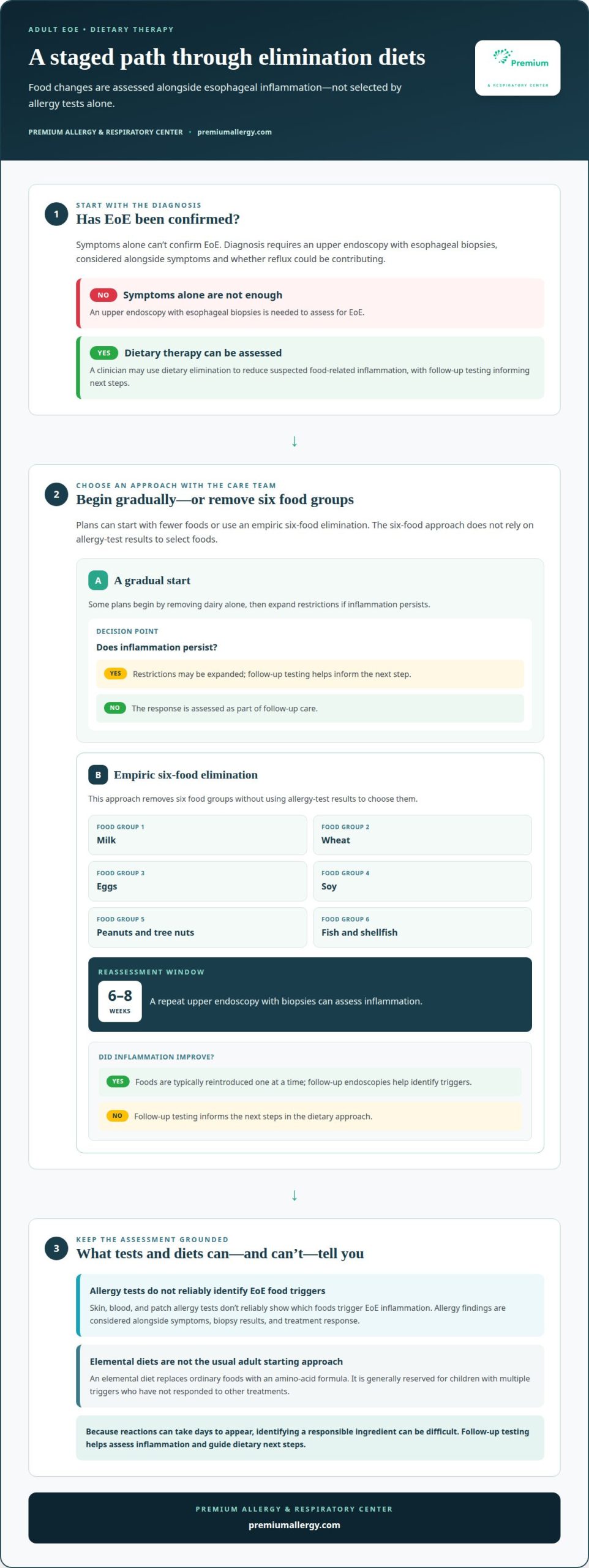
Adult EoE dietary therapy removes suspected foods, then uses follow-up to assess changes in inflammation. Because the plan can be restrictive, choosing a starting point matters. Some adults begin by eliminating dairy alone; others consider broader approaches based on symptoms, prior treatment, and biopsy findings. Allergy tests don’t reliably identify EoE food triggers and shouldn’t determine the diet by themselves.
A six-food elimination diet removes milk, wheat, eggs, soy, peanuts and tree nuts, and fish and shellfish. Less restrictive options may remove fewer foods first. For example, a four-food plan removes milk, egg, wheat, and legumes. The gastroenterologist and patient can weigh manageable restrictions against the need to assess inflammation. Removing more foods can make meals harder to plan, while a narrower plan may need further adjustments.
Reintroduction is part of dietary therapy, not an afterthought. Foods are typically added back one at a time, with follow-up endoscopies helping identify triggers. A repeat endoscopy after 6 to 8 weeks can assess response to a six-food plan. Symptoms alone may not show whether esophageal inflammation has settled, so tissue assessment helps guide the next food changes.
A dietitian isn’t automatically necessary for every adult, but can help make a restricted plan workable. They can review meals, suggest practical substitutes, and help maintain variety while foods are removed. This support can be especially useful when several familiar ingredients are excluded or grocery choices and shared meals become difficult. Consider dietitian support if planning feels burdensome or restrictions keep expanding.
Elemental nutrition uses an amino-acid formula instead of ordinary foods. It’s generally reserved for children with multiple triggers who haven’t responded to other treatments, rather than serving as a routine adult starting plan. For separate concerns about immediate food allergies, explore food allergy testing; it doesn’t reliably identify EoE triggers.
Premium Allergy & Respiratory Center supports adults managing allergic conditions alongside EoE. EoE diagnosis and esophageal monitoring involve a gastroenterologist, while coordinated allergy care can address related concerns such as food allergies, asthma, or allergic rhinitis. Food allergy testing may provide information about suspected allergies, but it doesn’t reliably identify EoE food triggers or replace endoscopy and biopsies.
Consider allergy care when symptoms or known allergic conditions are part of your broader health picture. Premium Allergy & Respiratory Center offers Food Allergy Testing, Asthma Management, and Allergic Rhinitis Treatment. These services address allergy-related needs that may accompany EoE, while your gastroenterologist guides assessment and treatment of the esophagus.
For support with related allergic concerns, contact Premium Allergy & Respiratory Center.
Living with EoE can make everyday choices, from meals to treatment discussions, feel more complicated. Bring your priorities into the conversation: how you want eating to feel, which changes seem manageable, and what questions remain. For adults considering EoE treatment in Clovis, a plan built around those priorities can make ongoing care more practical and personal.
Keep a short record of concerns to discuss, such as foods that feel difficult or how symptoms affect daily routines. Share it with the specialists involved in your care so your next conversation can focus on decisions that matter to you. Allergy-related concerns can be part of that discussion too.
For support with allergy and respiratory concerns, contact Premium Allergy & Respiratory Center. A thoughtful next conversation can help you move forward with greater clarity and confidence.
EoE diagnosis combines symptoms with tissue findings from an upper endoscopy and esophageal biopsies. A clinician may collect multiple samples because inflammation can vary across the esophagus. A biopsy showing 15 or more eosinophils per high-powered microscopic field is highly suggestive of EoE. Evaluation also considers gastroesophageal reflux disease, which can contribute to eosinophils in esophageal tissue.
For adults seeking EoE treatment in Clovis, care may combine medication, dietary changes, or both, with follow-up to assess the esophagus. Proton pump inhibitors are often used as an initial treatment. If they don’t control the condition, swallowed topical corticosteroids may be considered. For adults with narrowing that causes swallowing difficulty, a gastroenterologist may consider dilation. Dilation can improve food passage, but it doesn’t treat the underlying inflammation.
Eosinophilic esophagitis is a chronic inflammatory condition in which eosinophils, a type of white blood cell, build up in the esophageal lining. Eosinophils aren’t normally present there. Their accumulation can inflame the tissue and affect how food moves toward the stomach. EoE differs from acid reflux, which involves stomach acid flowing back into the esophagus, though both conditions may be considered during evaluation.
Adults with EoE may have difficulty swallowing, food sticking during a meal, chest pain, heartburn, or upper abdominal pain. These symptoms can resemble other digestive problems, so they don’t confirm EoE on their own. Notice whether swallowing trouble occurs with particular textures, such as dense solids, and whether episodes recur. That pattern can help a clinician understand what you’re experiencing.
EoE is chronic, but ongoing treatment and monitoring can help control inflammation and reduce the chance of complications. For adults considering EoE treatment in Clovis, follow-up assessment helps evaluate treatment response because symptoms may not fully reflect what’s happening in the esophagus. If inflammation remains uncontrolled, scarring or narrowing may develop and make swallowing harder. A sustained care plan focuses on symptom management and esophageal health.
EoE affects both children and adults. It is associated with food and environmental allergies, asthma, and atopic dermatitis, although these conditions alone don’t establish an EoE diagnosis. Adults may seek evaluation because swallowing feels difficult or food seems to lodge during meals. A history of allergic conditions can provide useful context for the clinician assessing symptoms and test results.
A body-wide reaction can look like several unrelated problems at once. Mast cell activation syndrome (MCAS) occurs when mast cells release mediators... Continue reading
READ MORE
Symptoms alone can’t confirm EoE. For adults seeking EoE treatment in Clovis, diagnosis requires an upper endoscopy with esophageal biopsies, which... Continue reading
READ MORE
The test itself is only part of the picture; what you do afterward matters, too. Knowing how to prepare for an allergy test starts with reviewing... Continue reading
READ MORE
A gastroenterologist typically leads the diagnosis of eosinophilic esophagitis (EoE). An upper endoscopy with esophageal biopsies is needed to... Continue reading
READ MORE