
Breathing symptoms that keep returning deserve timely attention, particularly when they disrupt sleep, activity, or everyday routines. If you’re... Continue reading
READ MORE

A negative allergy blood test doesn’t always close the case. The test measures allergen-specific IgE antibodies in your blood, and getting allergy test results explained means reading them alongside your symptoms and medical history. The blood draw usually takes less than five minutes.
It’s natural to want a clear yes-or-no answer from a test result. But a positive result can show sensitization without proving that exposure causes symptoms, and a negative result can make an allergy less likely without ruling it out completely.
This guide explains what allergy blood test results can and can’t tell you, how they compare with skin testing and supervised food challenges, and why your medical history matters. You’ll also learn how clinicians assess possible false-positive and false-negative results, so you can understand what a result may mean and what questions it raises.
An allergy blood test analyzes a blood sample for immunoglobulin E, or IgE antibodies. Food-specific tests measure IgE directed at a particular food allergen. A milk test, for example, looks for milk-specific IgE, while a peanut test looks for peanut-specific IgE. These results show whether sensitization is present, but don’t establish on their own whether eating that food causes symptoms. A blood draw usually takes less than five minutes and may cause brief soreness or bruising.
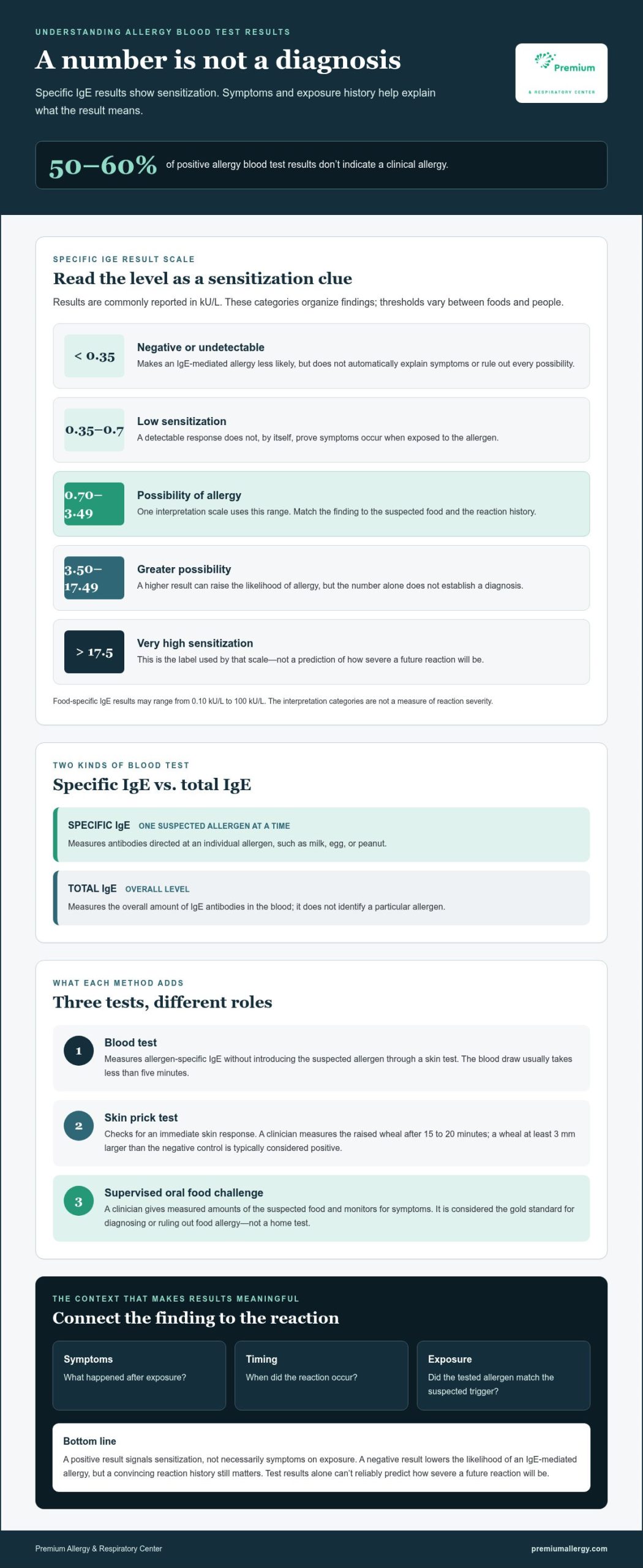
Skin prick testing checks for an immediate skin response to selected allergens. A clinician introduces a small amount of allergen extract, then measures any raised wheal after 15 to 20 minutes. A wheal at least 3 mm larger than the negative control is typically considered positive. Skin tests and blood tests each have limitations, and skin testing may not be suitable in every situation. Allergy testing works best when the suspected allergen matches the person’s symptoms and exposure history.
Blood testing may be used when skin testing isn’t practical or safe. Certain skin conditions can make skin test results difficult to interpret, and some medicines can interfere with testing. A provider may also choose a blood test when skin-test allergens could pose a serious reaction risk. Antihistamines are a common consideration: they can affect skin test results, and stopping them may worsen symptoms. Blood testing avoids this specific interference. Tell the provider about every medicine you take, and don’t stop any medicine unless instructed.
A negative blood result can reduce the likelihood of an IgE-mediated allergy, but symptoms still matter. For example, a child with a 0 mm milk skin test and undetectable milk-specific IgE has an IgE-mediated milk allergy that is highly unlikely. If a convincing reaction history conflicts with negative tests, a supervised oral food challenge may help clarify the diagnosis. During a challenge, the suspected food is eaten in measured amounts under medical supervision. It isn’t a home test.
Food-specific IgE testing differs from a total IgE test. Total IgE measures the overall amount of IgE antibodies in the blood; it doesn’t identify a particular allergen. Specific IgE testing measures antibodies to one suspected allergen at a time, such as egg or peanut. A positive result indicates sensitization, not proof of a clinical allergy. The next step is to compare the allergen tested with the timing and type of symptoms. That context helps make blood and skin test findings more meaningful.
In the United States, test costs depend on the test type, allergens included, and clinical evaluation; insurance coverage varies by plan and medical need.
Interpreting results means comparing the measured IgE response with symptoms and exposure history. Having allergy test results explained in that context helps distinguish a laboratory finding from a diagnosis. About 50% to 60% of positive allergy blood test results don’t indicate a clinical allergy. A positive result becomes more relevant when it matches symptoms after exposure to the tested food.
Specific IgE results estimate sensitization to one allergen, with levels commonly reported in kU/L. A result below 0.35 kU/L is considered negative or undetectable, while 0.35 to 0.7 kU/L suggests low sensitization. Higher results can raise the likelihood of allergy, but thresholds vary between foods and people. Allergy test results explained without symptom context can’t reliably predict how severe a future reaction will be.
Food-specific IgE results may range from 0.10 kU/L to 100 kU/L. One interpretation scale describes 0.70 to 3.49 kU/L as a possibility of allergy, and 3.50 to 17.49 kU/L as a greater possibility. Levels above 17.5 kU/L indicate very high sensitization on that scale. These categories organize findings, but symptoms and the suspected food remain central to diagnosis.
Blood tests can be useful when skin testing raises concern, including a possible serious reaction to skin-test allergens. A blood sample measures antibodies without introducing the suspected allergen through a skin test. The needle may cause brief pain or bruising. The blood test itself doesn’t expose you to the suspected food, but a clinician still needs to interpret the results in context.
A supervised oral food challenge can help clarify uncertain findings. It’s considered the gold standard for diagnosing or ruling out food allergy. A clinician gives measured amounts of the suspected food and monitors for symptoms. An elimination diet instead removes a suspected food while symptoms are tracked. Reintroducing foods without medical guidance can complicate assessment, especially after a concerning reaction.
Broad, non-selective test panels can produce findings that don’t match your symptoms. Testing specific foods based on a clear reaction history makes results more useful. For suspected food reactions, Food Allergy Testing can be part of a focused evaluation.
Skin prick tests tend to be more accurate than allergy blood tests. Neither test alone confirms or rules out a food allergy; symptoms and exposure history help explain what a positive or negative finding means.
A false-positive skin prick result shows a reaction during testing without proving that eating the food causes symptoms. About 50% to 60% of food skin prick tests yield false-positive results. A raised wheal can reflect sensitization, which means the immune system recognizes a substance. It doesn’t automatically mean the patient will react after eating it.
Cross-reactivity can also explain positive results. Proteins in related foods may resemble each other, so a skin test can react to a food someone eats without symptoms. Positive tests to related foods, for example, don’t establish separate clinical allergies. Wheal size matters, but it isn’t a perfect predictor. A larger wheal is generally more likely to indicate a true food allergy, yet it can’t determine reaction severity or predict anaphylaxis.
A false-negative result occurs when a test indicates no allergy despite a real allergic reaction. Blood tests can sometimes miss an allergy, so a negative result needs context. For example, symptoms that repeatedly follow eating a particular food remain relevant even if the specific IgE test is negative. A negative result makes an allergy less likely, but doesn’t rule it out.
The timing and type of reaction also matter. IgE tests assess an IgE response, so they may not explain symptoms that don’t follow an IgE-mediated pattern. A person with a negative food test but a convincing reaction history may need further evaluation. A supervised oral food challenge can help resolve uncertainty, with the food introduced under medical supervision rather than tested at home.
Skin prick tests tend to be more accurate than blood tests, but accuracy depends on the allergen and clinical context. Antihistamines and certain skin conditions can affect skin test results. Blood tests measure allergen-specific IgE without relying on a skin response. This makes blood testing useful when skin testing can’t be performed reliably, though it doesn’t make every blood result definitive.
With either method, a positive result indicates sensitization, not necessarily symptoms after exposure. A negative result makes allergy less likely, but any mismatch with your experience deserves attention. Record the suspected food, the amount eaten, the timing, and the symptoms. These details help interpret conflicting results and guide decisions about whether another test, including a supervised challenge, could clarify the diagnosis.
Test results can guide treatment and allergen avoidance when they fit your symptoms and exposure history. A positive result may support focused precautions or further evaluation, while a negative result can prompt a closer look at the suspected trigger.
A positive allergy test shows sensitization, meaning the immune system recognizes an allergen, but it doesn’t prove that exposure causes symptoms. That distinction matters before removing foods or changing treatment. For example, a positive peanut test without symptoms after eating peanut needs a different interpretation from a result that matches a clear reaction.
A focused medical history connects the laboratory finding to real-life exposure. Note what you encountered, when symptoms began, what happened, and whether the reaction repeated. Include food-related discomfort, unexplained reactions, self-restricted diets, and recurring digestive, skin, or respiratory symptoms. These details help distinguish a result that matches your experience from one that may not explain it.
Skin test findings also need context. A positive skin prick test can produce a raised white wheal surrounded by itchy, red skin. That visible response indicates sensitization, not a diagnosis by itself. A wheal after testing for milk, for instance, must be considered alongside milk exposure and symptoms. Antihistamines can interfere with skin tests, so your medication history matters when interpreting results.
Allergist interpretation combines medical history with test findings to assess whether an allergy diagnosis fits. This matters because both blood and skin tests can produce false-positive or false-negative results. An allergist considers the suspected allergen, reaction pattern, and relevant symptoms before recommending further evaluation or management.
Bring a clear record of reactions to your appointment. Include the suspected exposure, symptom type, timing, and any food or medicine you began avoiding. Mention asthma, recurring rashes, digestive symptoms, and medicines, including antihistamines. A pattern of breathing symptoms after an insect sting, for example, calls for a different assessment than an isolated, mild skin change.
Your medical history can also show when specialist evaluation may be especially useful. Unclear or conflicting results, suspected severe allergy or anaphylaxis, complex sensitization, and unresolved symptoms are reasons to consider specialist care. A clinician weighs these details to decide whether additional testing could clarify the diagnosis. This can make avoidance more targeted and keep treatment decisions tied to actual symptoms, rather than test numbers alone.
A negative result makes an allergy to the specific allergen tested less likely, but it doesn’t always explain a reaction. For example, a negative peanut-specific IgE result concerns that test’s target, not every possible cause of symptoms after eating. Match the report to the food, medicine, or sting involved, then compare it with what happened after exposure.
Test scope matters. A specific IgE blood test measures the immune response to one allergen, so a result for one food doesn’t answer questions about another. A negative egg result, for instance, says nothing about a suspected reaction to milk. Check the allergen name on the report and note whether it matches the exposure linked to your symptoms.
Skin testing provides another piece of evidence. If no wheal appears during a skin prick test, allergy to the tested food is less likely. Still, the result must be considered alongside your reaction history. Write down what was eaten, the symptoms, and when they began. Repeated symptoms after the same food deserve attention even when the corresponding test is negative.
Some reactions call for a different diagnostic approach. An oral food challenge may be considered when symptoms suggest an allergy despite negative testing. During this supervised test, the suspected food is introduced in measured amounts while symptoms are observed. It can help clarify whether eating that food causes a clinical reaction. Never use a home reintroduction as a substitute for a supervised challenge, especially after a serious reaction.
An allergy can also change over time. A child may outgrow an allergy, and periodic retesting can track changes. A past positive result and a current negative result therefore need to be understood in context, including previous reactions and current exposures. Don’t assume a change in a report means the earlier reaction didn’t happen. It may mean the allergy picture has shifted.
A negative result can also coexist with a false-positive result elsewhere on a broad panel. For example, a positive test to a food eaten without symptoms doesn’t establish a clinical allergy, while a negative result for the suspected trigger still leaves the original reaction to assess. Keep a simple record of exposures and symptoms for each event. This helps focus further evaluation on the relevant allergen instead of unrelated results.
If symptoms persist despite negative testing, discuss your allergy test results as part of a focused evaluation. Bring the report and your exposure notes, including the suspected trigger, reaction, and timing.
Premium Allergy & Respiratory Center offers Allergic Rhinitis Treatment for people managing allergy-related nasal symptoms. If your test results don’t seem to match your symptoms, an evaluation can consider your history alongside testing rather than relying on one result alone. This can help clarify possible triggers and guide discussion of treatment and allergen avoidance.
For concerns involving food or medication reactions, the center also offers Food Allergy Testing and Penicillin Allergy Testing. Asthma Management is available when asthma is part of your allergy concerns. Bring your test report and a record of symptoms and exposures to help keep the conversation focused.
Contact Premium Allergy & Respiratory Center or visit premiumallergy.com to explore your next step.
Your test report can be a starting point, not the final word on what’s affecting your health. Having allergy test results explained alongside your symptoms can help you focus on the questions that matter: which exposures may be relevant, what evaluation could clarify the picture, and how to manage symptoms in daily life.
If you’re still dealing with nasal symptoms, asthma concerns, or suspected food reactions, Premium Allergy & Respiratory Center offers Allergic Rhinitis Treatment, Asthma Management, and Food Allergy Testing. Bring your test report and notes about symptoms or exposures to help guide a focused conversation about care.
Contact Premium Allergy & Respiratory Center to discuss a next step. Clearer answers can help you move forward with greater confidence.
Allergy blood testing can cause slight pain or bruising where the needle enters, and these effects usually fade quickly. Skin prick testing can cause an itchy, raised spot at the test site. Because skin testing introduces allergen extracts, a provider may choose blood testing when there’s concern about a serious reaction. Tell the testing team about your medicines, skin conditions, and past severe reactions before testing begins.
Results show how your immune system responded to the specific allergens tested, not every possible trigger. A positive finding can indicate possible sensitization; a negative result makes an allergy to that tested substance less likely. For example, a report listing a positive result for one tree pollen doesn’t establish an allergy to other pollens. Match each result to the exposure and symptoms it may explain.
Contact your healthcare provider when symptoms continue despite a negative result, or when your report conflicts with a clear reaction history. Share the allergen tested, what you encountered, and when symptoms began. Seek prompt medical attention for a suspected severe reaction or anaphylaxis. Specialist assessment is especially relevant when results are unclear, symptoms remain unresolved, or further diagnostic evaluation is needed.
Results are interpreted by comparing the tested allergen with your symptoms, exposure history, and test method. Keep a simple log of the suspected trigger, what happened, and whether the same pattern occurred again. For instance, symptoms after a particular meal may make a matching food result more relevant. A laboratory value or skin response is one part of diagnosis, not a stand-alone explanation.
A wheal is the raised area measured at the skin test site. It’s measured 15 to 20 minutes after the allergen extract is introduced. A wheal at least 3 mm larger than the negative control is typically considered positive. The size helps describe the skin response, but it can’t by itself confirm a clinical allergy or predict how severe a future reaction would be.
Specific IgE levels estimate the blood’s antibody response to one allergen, often in kU/L. A result below 0.35 kU/L is generally considered undetectable or negative; higher ranges indicate increasing sensitization. For example, 0.7 to 3.5 kU/L is described as moderate sensitization. These categories don’t predict reaction severity, and meaningful thresholds differ among allergens and individuals.
A positive test indicates sensitization, while a clinical allergy involves symptoms after exposure. For example, someone may test positive to a food yet eat it without symptoms. That result alone doesn’t establish a reason to avoid the food. An allergist considers exposure history and symptoms alongside the test, helping prevent unnecessary restrictions and identify when further assessment may clarify the diagnosis.
False-positive findings can occur when a test detects sensitization without symptoms or when related proteins cause cross-reactivity. False-negative results can occur even when someone has an allergy, so symptoms after exposure still matter. Antihistamines can interfere with skin testing, while a blood test may be selected if those medicines can’t be stopped. Choosing a focused test and recording a detailed reaction history can help explain unexpected results.
Breathing symptoms that keep returning deserve timely attention, particularly when they disrupt sleep, activity, or everyday routines. If you’re... Continue reading
READ MORE
A negative allergy blood test doesn’t always close the case. The test measures allergen-specific IgE antibodies in your blood, and getting allergy... Continue reading
READ MORE
An allergist can evaluate sinus symptoms when allergies may be contributing. The Centers for Medicare & Medicaid Services says allergy testing... Continue reading
READ MORE
A penicillin allergy label doesn’t prove you’re still allergic: about 90% of people who report one aren’t allergic to penicillin. A true... Continue reading
READ MORE